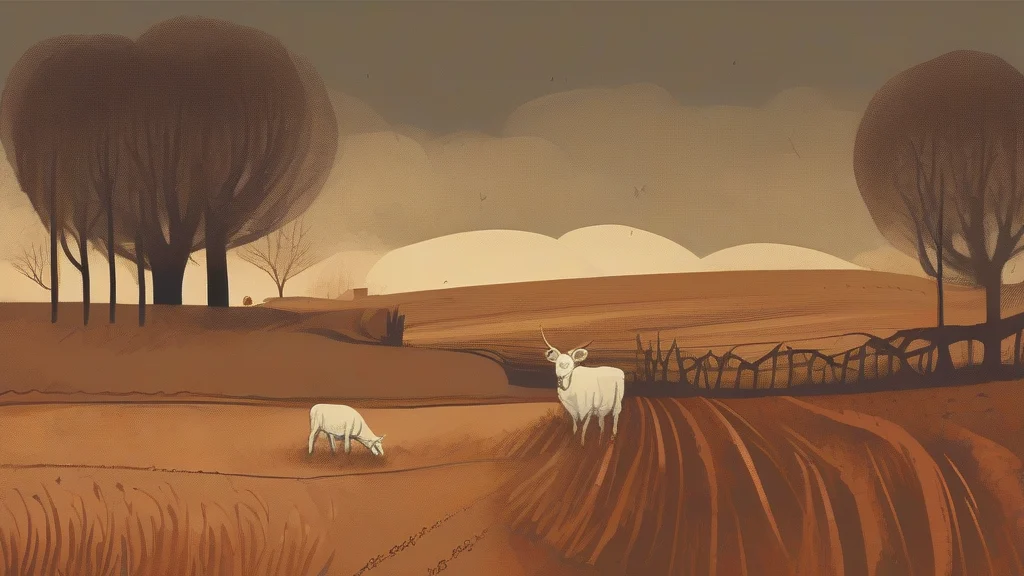
What does fallowing mean?
Fallowing is the practice of leaving cultivated land unsown for one or more growing seasons so that the soil can recover its fertility naturally. By resting, a field regains nutrients, moisture, and microbial life that continuous cropping would exhaust, which is why farmers have used the technique since antiquity. In modern agriculture, deliberate fallowing has largely given way to crop rotation and cover cropping, but the term survives both as an agricultural technicality and as a vivid metaphor: writers and thinkers speak of fallowing periods of rest during which ideas, careers, or creative energies are left deliberately dormant before renewed growth. The word carries a connotation of purposeful patience rather than neglect — the ground is not abandoned, but trusted to renew itself. Its best-known form is the phrase 'to lie fallow,' which remains common in both literal farming contexts and figurative prose about pausing productively.
Present participle of 'fallow': leaving arable land unsown for a period to restore its fertility, or figuratively, allowing something to rest idle in anticipation of renewal.
"The estate has been fallowing its poorest fields for two seasons now."
The practice or process of leaving land uncultivated so that it recovers; occasionally extended to any deliberate period of rest or dormancy.
"Regular fallowing kept the smallholding productive without artificial fertilizers."
As a noun, usually appears in agricultural or academic discussion rather than everyday speech.
Reviewed by Deb Chak, Editor. AI-assisted content curated by RJS Tech Solutions LLP.
Etymology of fallowing
Fallowing derives from the adjective 'fallow,' meaning plowed but unsown, which entered Middle English from Old English 'fealg' or related Germanic forms; the ultimate root is Proto-Germanic and relates to the pale, tilled appearance of unplanted earth. The same Old English word gave rise to 'fallow deer,' named for its pale brownish coat. The verb form developed later from the adjective, describing the act of leaving ground in this rested state.
Related word forms
How fallowing is actually used
Mostly agricultural in register but increasingly used metaphorically in writing about creativity, productivity, and personal renewal. The related phrase 'lie fallow' is far more common than the verb form itself.
Easily confused with fallowing
'Following' means coming after or pursuing, while 'fallowing' refers to leaving land uncultivated to restore its fertility.