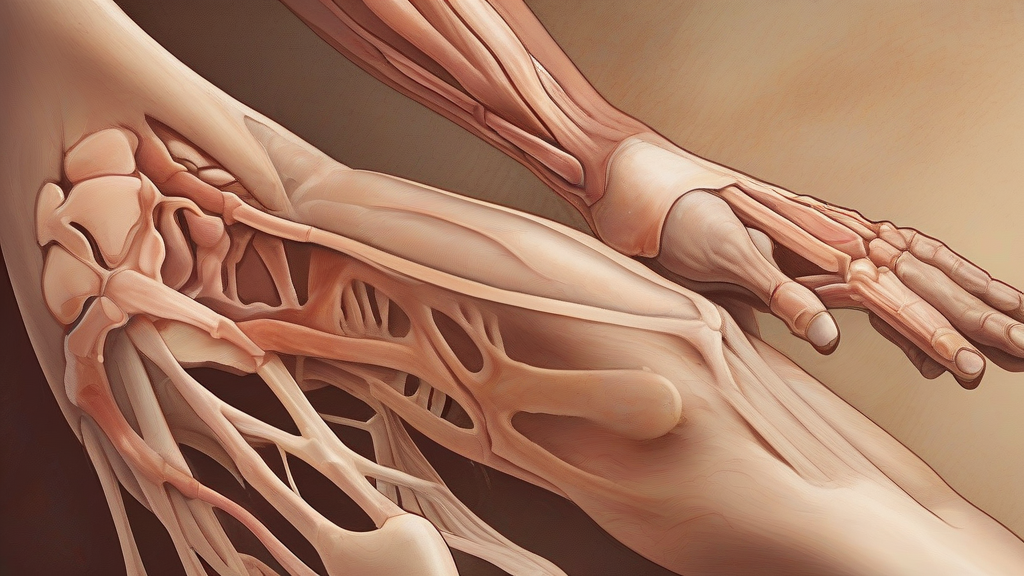
What does fascia mean?
Fascia (plural: fascias or, in medical use, fasciae) most commonly means a thin sheet or band of fibrous connective tissue that wraps around muscles, organs, blood vessels, and nerves throughout the body. Long treated by anatomists as mere packing material, fascia is now recognised as an active, sensory structure that transmits force and contributes to movement and posture, making it a buzzword in physiotherapy, fitness, and practices like myofascial release. A second, entirely distinct sense covers flat bands in building: the fascia board runs horizontally along a roof's eaves, hiding rafter ends and supporting gutters. In Britain, 'fascia' can also mean a car's dashboard. Derived from Latin fascia, meaning a band or strip of cloth, the word entered English in the sixteenth century. Its dual life — inside the body and on the outside of buildings — makes it a word shared uneasily between surgeons and builders.
A sheet or band of fibrous connective tissue that surrounds muscles, organs, and other structures in the body.
"The physiotherapist worked to loosen the fascia in the patient's shoulder."
Plural is 'fasciae' in medical contexts.
A flat horizontal band or board, especially one fixed along the edge of a roof at the eaves, or the dashboard panel of a vehicle.
"They repainted the fascia and soffits before putting the house on the market."
British English uses 'fascia' for a car dashboard; American English generally does not.
'Fascias' is the standard plural in general and building contexts. 'Fasciae' is preferred in medical and anatomical writing, preserving the Latin pluralisation.
"The surgeon incised the fasciae overlying the muscle group."
The same Latin word that gave us the fasces — the Roman symbol of authority — also names the clingy tissue wrapping every muscle in your body.
Reviewed by Deb Chak, Editor. AI-assisted content curated by RJS Tech Solutions LLP.
Etymology of fascia
Fascia comes directly from Latin fascia, meaning 'a band, bandage, or strip of cloth'. It entered English in the mid-sixteenth century, initially referring to bandages and later to architectural bands. The same Latin root produced Italian fascio ('bundle') and underlies fasces — the bound bundle of rods carried by Roman magistrates — from which Benito Mussolini's fascism takes its name. Related English derivatives include fascinate, whose original sense involved binding or casting a spell, and fascicle, a small bundle.
How fascia is actually used
In British English, 'fascia' is common for a car's dashboard ('dashboard fascia'), whereas American English rarely uses it this way; Americans say 'dash' or 'instrument panel'. In anatomy and fitness contexts — yoga, myofascial release, physiotherapy — 'fascia' has become prominent since the 2000s. The plural is 'fasciae' in medical usage, though 'fascias' is standard in building and general contexts.
Easily confused with fascia
Though both begin with 'fac-', 'fascia' refers to a band of tissue or trim board, while 'face' refers to the front of the head or a surface.
'Fescue' is a type of grass, unrelated in meaning to 'fascia', despite some similarity in form.