
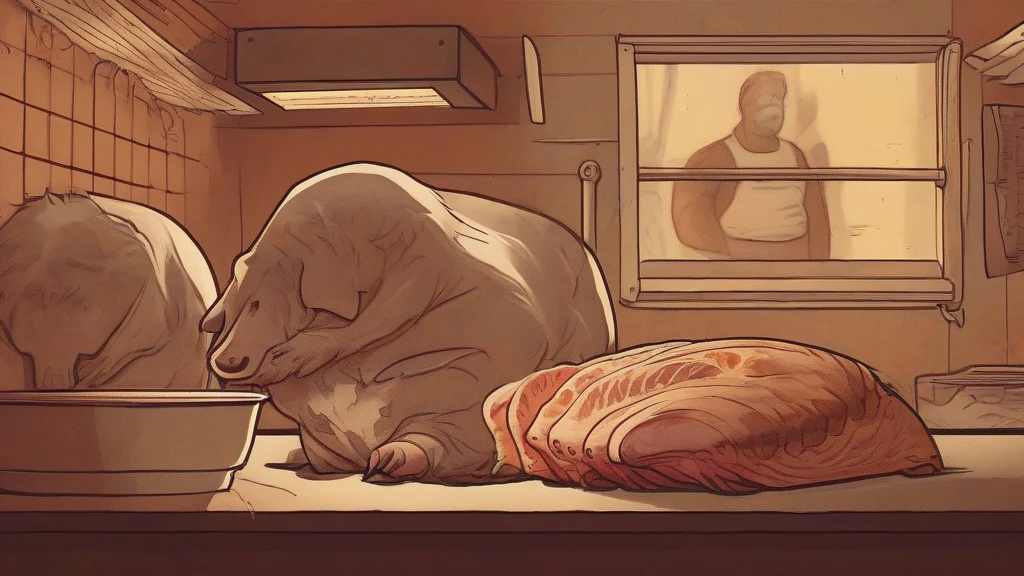
What does fatting mean?
'Fatting' is the present participle of the verb 'to fat', which means to make or become fat, most often by feeding. Historically it was chiefly an agricultural term: farmers would speak of fatting cattle, pigs, or poultry before sending them to market, deliberately feeding them to increase their value as meat. The word derives simply from the adjective 'fat', one of the oldest words in English, traceable through Old English 'fætt' back to Germanic roots and related to the Latin 'pinguis' only in meaning rather than origin. Over time 'fatten' and especially 'fattening' displaced 'fatting' in everyday use, and today 'fatting' survives mainly in older texts and regional speech. Readers encountering it should understand it as a synonym of fattening in its literal sense, not to be confused with figurative uses about enriching oneself.
verbFatting is the present participle of the verb 'to fat', meaning to make or become fat, or to feed animals for slaughter so they put on weight. It is now largely replaced by the more common form 'fattening'.
- The act of feeding animals (or people) to make them fatter; putting on weight.
- (Of food) contributing to weight gain — though this sense is normally expressed with 'fattening', not 'fatting'.
"The farmer spent the autumn fatting his cattle before market."
"The pigs were fatting well on the kitchen scraps."
"He accused the rich of fatting themselves at the expense of the poor."
Before 'fattening' took over, English farmers spoke of 'fatting' their livestock — a word that has all but vanished from modern dictionaries.
Reviewed by Deb Chak, Editor. AI-assisted content curated by RJS Tech Solutions LLP.
Etymology of fatting
'Fatting' comes from the verb 'fat', formed directly from the Old English adjective 'fætt' ('fat'), which itself traces back through Germanic origins. The verbal sense of fattening livestock is old and appears in agricultural usage over several centuries. The derived form 'fatten' eventually became the dominant verb, leaving 'fatting' as a rarer variant found mostly in older or dialectal writing.
Related word forms
How fatting is actually used
Rare and somewhat archaic today; in contemporary English 'fattening' is almost always used instead. When encountered, it typically appears in older agricultural writing or dialect contexts.
Easily confused with fatting
'Fattening' is the standard, near-universal present participle of both 'to fatten' and the sense of food that causes weight gain, whereas 'fatting' is an older, now rare variant.