What does favela mean?
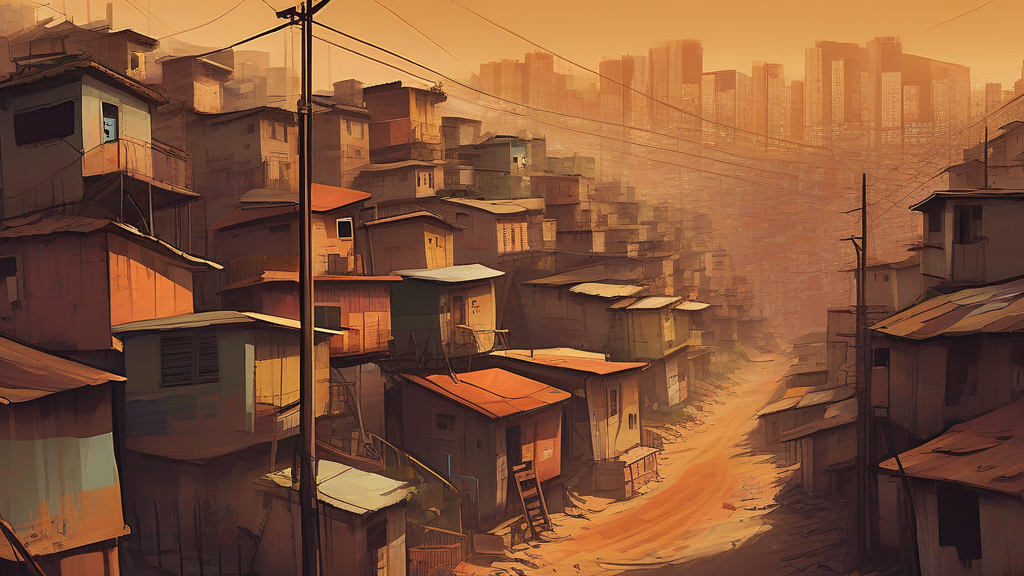
A favela is an informal settlement or shantytown in Brazil, made up of densely packed, self-built homes that often lack formal sanitation, legal land title, or reliable public services. Though such communities exist worldwide, the word is tied specifically to Brazil, evoking the famous hillside neighborhoods of Rio de Janeiro and São Paulo. Favelas are frequently portrayed as places of hardship, but they are also vibrant communities with rich cultural life — the birthplace of samba, funk carioca, and much of Brazilian footballing talent. In English writing the term functions as a noun with a standard plural ('favelas') and is largely neutral in register, though careless use as a generic synonym for 'slum' can come across as insensitive. Its origin lies in Portuguese, ultimately linked to the name of a spiny Brazilian shrub, giving the word a distinctive history rooted in Brazil itself.
A shantytown or informal settlement of makeshift housing in Brazil, typically built on unoccupied land and often lacking adequate sanitation and other services.
"Tourists on the guided walk learned how the favela had organized its own refuse collection when the city would not provide one."
Used almost exclusively of Brazilian settlements; the plural 'favelas' is standard in English.
Figuratively, any densely populated, impoverished urban neighborhood resembling a Brazilian shantytown.
"Critics condemned the plan as creating a favela on the city's outskirts."
This extended sense is looser and less common, and can be perceived as derogatory when applied outside Brazil.
The regular English plural is standard; no alternative form is in common use.
"Dozens of favelas cling to the steep hillsides overlooking Guanabara Bay."
The word comes from a spiny Brazilian shrub named for its bean-like leaves — and it was the name of a hill where soldiers awaited a battle that gave the first 'favela' its name.
Reviewed by Deb Chak, Editor. AI-assisted content curated by RJS Tech Solutions LLP.
Etymology of favela
The word entered English from Brazilian Portuguese in the late 19th or early 20th century. It derives from the Portuguese name for a spiny shrub of the Euphorbiaceae family, whose bean-like leaves suggested the Latin 'faba', meaning 'bean'. The transfer to urban settlements began when soldiers returning to Rio de Janeiro from the Canudos campaign in Bahia settled on a hill they nicknamed after the shrub-covered Morro da Favela, and their improvised community became known by that name.
How favela is actually used
In English, 'favela' is used specifically of Brazilian settlements; applying it to settlements outside Brazil is generally considered loose or figurative. The word is descriptive rather than inherently derogatory, but writers should be mindful that it can carry stigmatizing overtones when used loosely for any slum. The anglicized plural 'favelas' is standard.
Easily confused with favela
A villa is a large, comfortable country house, while a favela is a poor informal settlement — nearly opposite connotations despite similar sound.