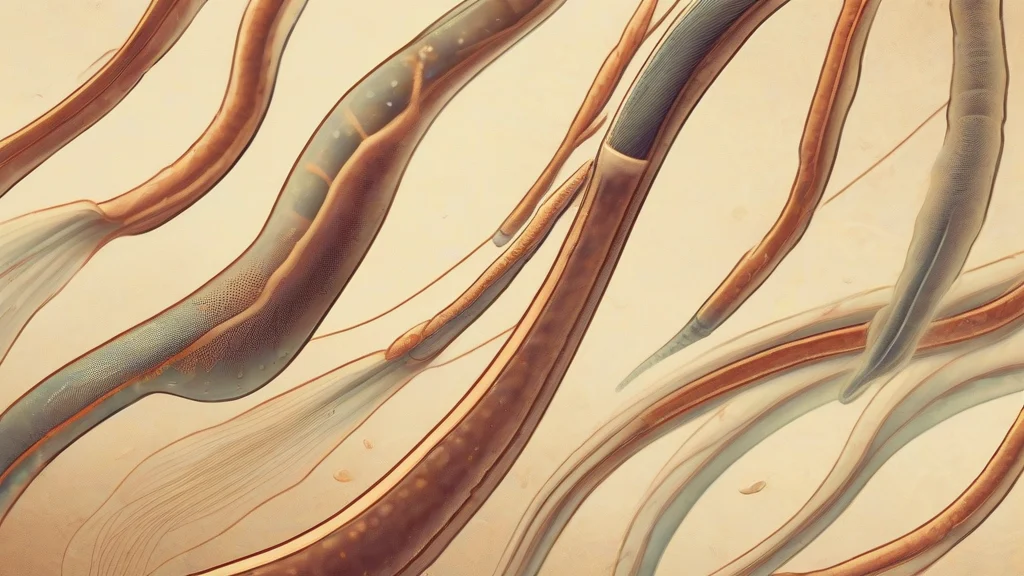
What does flagella mean?
Flagella are the long, slender, whip-like appendages that many single-celled organisms use to move through liquid environments. The word is simply the plural of flagellum, and it appears throughout microbiology and cell biology to describe structures on bacteria, archaea, protozoa, and even animal sperm cells. In bacteria, each flagellum is anchored in the cell membrane and rotates like a corkscrew-shaped propeller, allowing remarkable speed and maneuverability; in eukaryotic cells, flagella instead beat with a flexible, wave-like motion. Although superficially similar to cilia, the shorter hair-like projections found on some cells, flagella are typically far longer and fewer per cell. The term derives from the Latin flagrum, meaning whip, a heritage it shares with words for whipping and self-scouring. Almost entirely confined to scientific writing, flagella is nonetheless a vivid word whose very name evokes the lashing movement it describes, making it a memorable introduction to the hidden machinery of microscopic life.
nounFlagella are the long, whip-like appendages that many microorganisms, such as bacteria and protozoa, use for propulsion; the word is the plural of flagellum.
- The plural of flagellum: long, whip-like cellular appendages used by bacteria, archaea, and eukaryotes such as sperm cells and protozoa for locomotion or sensory function.
"The bacterium swam toward the nutrient gradient by rotating its flagella like tiny propellers."
"Under the microscope, the protozoan's flagella undulated rhythmically, driving it through the droplet."
"Sperm cells propel themselves forward with a single flagellum, while many bacteria carry several flagella distributed across their surface."
Flagella is itself the standard plural of the singular noun flagellum, borrowed directly from Latin; the plural is used unchanged in both British and American scientific English.
"Motile bacteria may possess one flagellum or many flagella arranged at one end, both ends, or all over the cell surface."
Some bacteria spin their flagella at over 1,000 revolutions per second — making them nature's most efficient rotary motors.
Reviewed by Deb Chak, Editor. AI-assisted content curated by RJS Tech Solutions LLP.
Etymology of flagella
Flagella derives from the Latin flagrum, meaning 'whip', via the neuter form flagellum ('little whip'), which was adopted into scientific Latin before entering English biological terminology. The same root gave rise to flagellation and flagellant, terms associated with the historical practice of ritual or disciplinary whipping. The word's figurative origin is apt: the appendages it names lash and whip through fluid with striking visual similarity to their lexical ancestor.
Related word forms
How flagella is actually used
Flagella is an exclusively scientific term, used almost entirely in microbiology, cell biology, and medicine; it rarely appears outside academic or technical contexts. It is the standard plural of flagellum in both British and American usage. Note that bacterial flagella rotate like a propeller, while eukaryotic flagella beat with a whiplashing motion — a distinction biologists frequently emphasize.
Easily confused with flagella
Cilia are shorter, hair-like projections that usually beat in a coordinated oar-like motion, whereas flagella are longer and typically move in a whip-like or rotating fashion.
The related verb 'to flagellate' can mean to whip or flog as punishment, but 'flagella' itself refers only to the biological appendages.