What does feijoada mean?
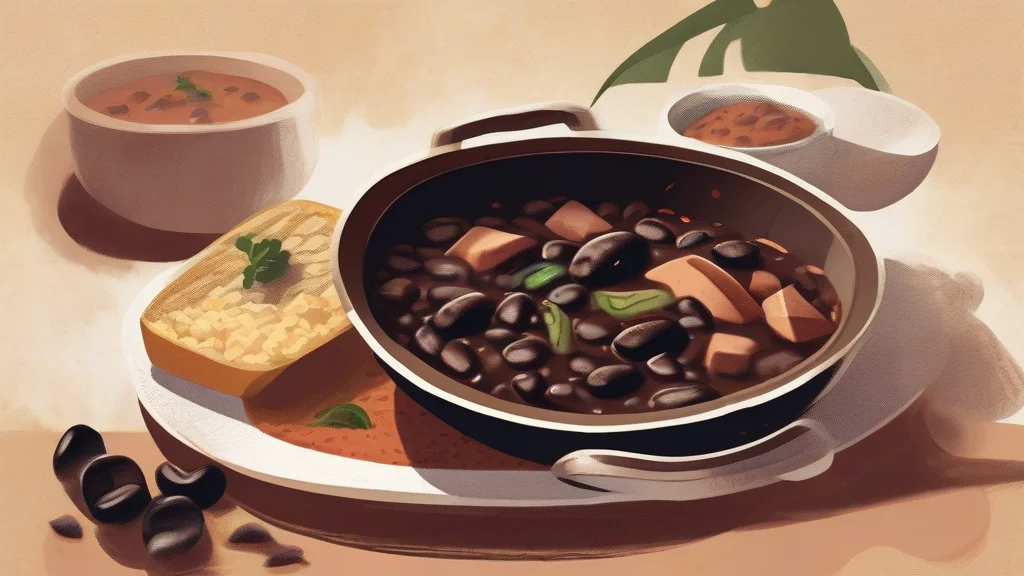
Feijoada is a rich, slow-cooked stew of black beans simmered with pork and beef, widely regarded as Brazil's national dish. The name comes from Portuguese feijão, meaning 'bean', and the dish exists in both Brazilian form — built on black beans with smoked meats such as sausage, bacon, and dried beef — and Portuguese versions made with white or red beans. Traditionally served at midday on Wednesdays or Saturdays, feijoada comes accompanied by white rice, sautéed collard greens, orange slices, and farofa (toasted cassava flour), with the oranges said to aid digestion of the heavy meal. In Brazil it is often described as feijoada completa when served with this full array of sides. Beyond its culinary role, feijoada carries strong cultural weight, evoking family gatherings and notions of shared national identity, making the word useful shorthand for Brazilian cuisine itself.
nounA hearty Brazilian stew of black beans cooked with pork or beef, served with rice and traditionally considered Brazil's national dish; also found in Portuguese cuisine with white or red beans.
- A Brazilian stew of black beans simmered with pork or beef, typically served with rice, collard greens, farofa, and orange slices.
- (In Portuguese cuisine) a similar bean-and-meat stew made with white or red beans rather than black beans.
"On Saturdays, the whole family gathers for a leisurely feijoada followed by an afternoon nap."
"The restaurant serves feijoada only on weekends, since the stew takes hours to prepare properly."
"After a morning at the beach, nothing satisfied them more than a steaming bowl of feijoada."
Pluralizes regularly in English; used mainly when referring to different varieties or multiple servings, though the word often functions as an uncountable mass noun.
"The cookbook compares feijoadas from Rio de Janeiro, São Paulo, and Minas Gerais."
Brazil's national dish was long said to have been invented by enslaved Africans using leftover beans and scraps — though historians note its roots are more European than that beloved legend suggests.
Reviewed by Deb Chak, Editor. AI-assisted content curated by RJS Tech Solutions LLP.
Etymology of feijoada
Feijoada derives from Portuguese feijão, 'bean', plus the suffix -ada, indicating a dish made from or abundance of something. Feijão traces back through Old Spanish and Portuguese to Latin phaseolus (from Greek phaselos), the word for a type of bean. Related forms include Spanish frijol and Romanian fasole, both descendants of the same Latin root, showing how widespread this bean-word became across Romance languages.
How feijoada is actually used
In English, feijoada is usually left unitalicized as a naturalized loanword and may take either a plural (feijoadas) when referring to servings or varieties, or remain uncounted as a mass noun. It carries warm, festive connotations, being strongly associated with family gatherings, restaurants' Saturday specials, and Brazilian national identity.
Easily confused with feijoada
A fajita is a Mexican dish of grilled seasoned meat in a tortilla, whereas feijoada is a Brazilian black-bean and pork stew.