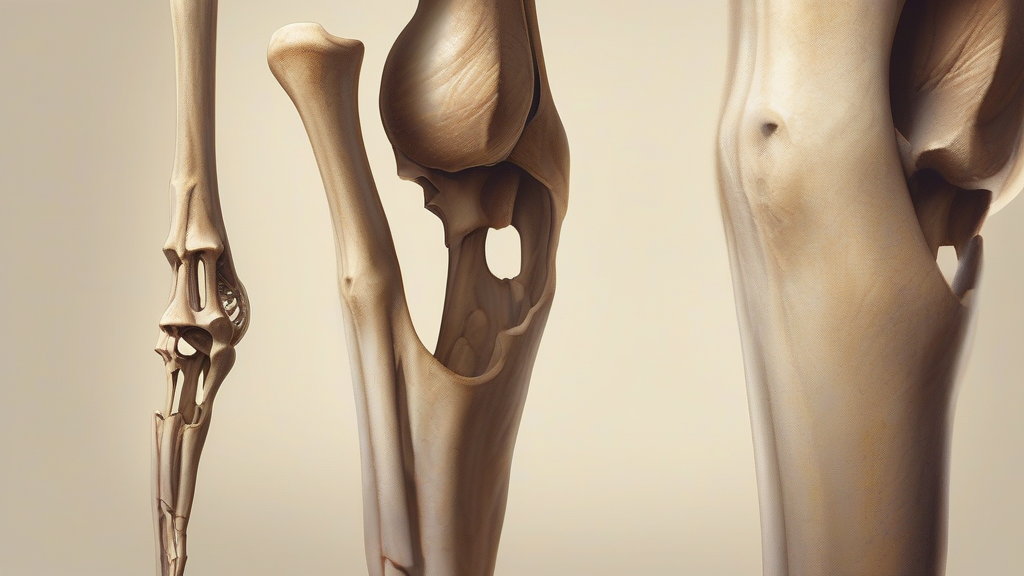
What does femur mean?
The femur is the bone of the thigh, extending from the hip to the knee, and in humans it holds two distinctions: it is both the longest and the strongest bone in the body, capable of withstanding enormous compressive forces. Because of its strength, fractures of the femur typically result only from significant trauma such as car accidents or falls from height, which makes the injury a serious one usually requiring surgical repair. In formal anatomy, related terms built on the adjective 'femoral' — as in 'femoral artery' — are common, and in entomology the word has a second life, denoting the thickened third segment of an insect's leg. English borrowed the word directly from Latin, where 'femur' meant thigh, tying it etymologically to words like 'feminine'. In casual conversation most speakers say 'thigh bone', keeping 'femur' for medical and scientific registers.
nounThe femur is the bone of the thigh, extending from the hip to the knee; it is the longest, strongest, and heaviest bone in the human body. In entomology, it also denotes the third segment of an insect's leg.
- The thigh bone of humans or vertebrates, running from hip to knee — the longest and strongest bone in the human body.
- The third segment of an insect's leg, between the trochanter and the tibia (entomology).
"The surgeon explained that the fracture had occurred midway along the femur."
"The athlete's season ended when he broke his femur in the collision."
"Under the microscope, the beetle's enlarged femur was clearly adapted for jumping."
The anglicized plural 'femurs' is standard in general English, but medical and zoological texts traditionally use the Latin plural 'femora'.
"Both femurs were fractured in the accident; the radiographs of the femora confirmed complete healing months later."
Your femur is stronger than concrete by weight — and at around a quarter of your height, it's the single longest bone you own.
Reviewed by Deb Chak, Editor. AI-assisted content curated by RJS Tech Solutions LLP.
Etymology of femur
The word 'femur' comes directly from Latin, where it meant 'thigh' or 'thigh bone'. It was adopted into English anatomical vocabulary in the early modern period, when Latin remained the working language of medicine. Its ultimate root is the Proto-Indo-European *dʰeh₁(y)-, meaning 'to suckle', which also produced Latin 'femina' ('woman') and hence English words such as 'feminine', 'female', and 'femme'. Cognate forms appear across the Romance languages, reflecting the shared Latin inheritance.
Related word forms
How femur is actually used
In everyday speech, people often say simply 'thigh bone', reserving 'femur' for medical, anatomical, or scientific contexts. The plural is irregular: Latin 'femurs' is standard in general English, while the Latinate plural 'femora' is preferred in formal anatomical and zoological writing.
Easily confused with femur
Femur is the noun naming the thigh bone itself, while femoral is the adjective describing things relating to that bone, as in 'femoral artery'.