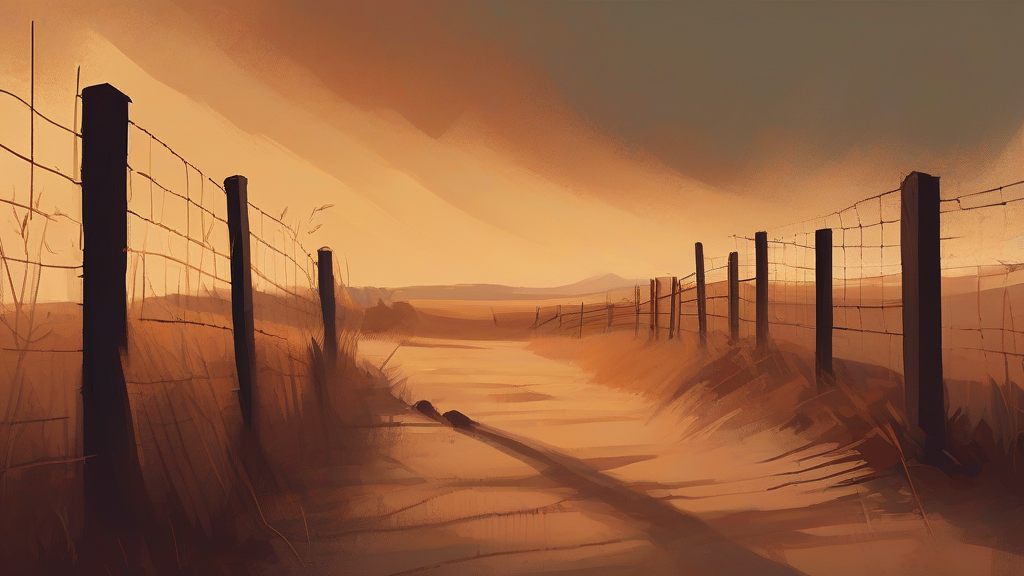
What does fenceless mean?
Fenceless is an adjective meaning lacking a fence or other enclosing barrier. It is most often used in literal, descriptive contexts — fenceless fields, fenceless prairies, or a fenceless boundary between properties — particularly in agricultural, rural, or landscape writing. Because it describes an absence rather than a presence, its connotation depends on context: a fenceless plain can suggest freedom, openness, and unbounded horizons, while a fenceless garden or yard may imply vulnerability, neglect, or exposure. The word is formed transparently from the noun 'fence' plus the suffix '-less', making its meaning immediately accessible even to readers encountering it for the first time. Though relatively rare in everyday speech compared with the phrase 'unfenced', it remains a precise and evocative choice in literary prose, historical accounts of open-range grazing, and discussions of land use. A figurative extension, describing situations or domains without boundaries or restrictions, appears occasionally in modern commentary.
Not having a fence; not enclosed by a fence or similar barrier.
"They grazed their herds on the fenceless rangeland of the high desert."
Most common in literary, agricultural, and historical contexts describing open land.
(Figurative) Without boundaries, limits, or restrictions.
"He imagined a fenceless web where information flowed freely between communities."
Rare and largely modern figurative extension of the literal sense.
Before the invention of barbed wire in 1874, vast stretches of the American West were truly fenceless — and 'fenceless' was a word people needed every day.
Reviewed by Deb Chak, Editor. AI-assisted content curated by RJS Tech Solutions LLP.
Etymology of fenceless
Fenceless is formed within English from the noun 'fence' plus the suffix '-less', meaning 'without'. The word 'fence' itself derives from Middle English 'fens', a shortened form of 'defence', which came from Old French 'defens' and ultimately from Latin 'defendere' ('to ward off, protect'). The suffix '-less' comes from Old English '-lēas', meaning 'free from' or 'devoid of'. Cognate words sharing this Latin root include 'defence', 'defense', 'offensive', and 'fend'.
How fenceless is actually used
'Fenceless' is a relatively uncommon word, appearing mostly in descriptive, literary, or agricultural writing about open land, pastures, and borders. It carries neutral to slightly poetic connotations, sometimes evoking openness or freedom and at other times exposure or lack of security. The figurative sense describing abstract boundaries (e.g., 'a fenceless internet') is rare but attested.
Easily confused with fenceless
'Defenseless' means lacking protection or ability to resist attack, while 'fenceless' literally means lacking a physical fence or enclosure.