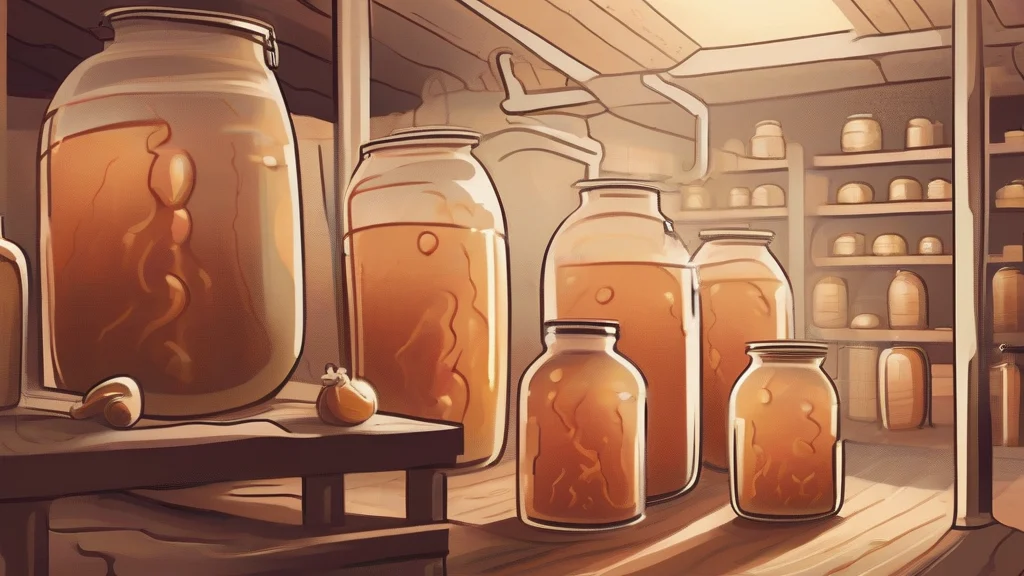
What does fermenting mean?
Fermenting is the present participle of the verb 'to ferment', describing the ongoing process by which microorganisms such as yeast and bacteria convert sugars into alcohol, acids, or gases. It is central to food and drink production: grapes are fermenting into wine, cabbage into sauerkraut, dough into leavened bread, and grain into beer. The word also appears in scientific contexts, where fermentation is studied as a metabolic pathway that releases energy without oxygen. Figuratively, the related noun 'ferment' conveys political or social unrest, echoing the bubbling energy of the literal process. Connotations depend on context — artisanal and wholesome in craft-food circles, hazardous when describing improperly stored food or drink. Understanding 'fermenting' opens a window onto one of humanity's oldest technologies, one that predates writing and remains vital to cuisine, industry, and biology alike.
Undergoing fermentation: being converted chemically by yeast, bacteria, or other microorganisms, often producing alcohol, acids, or gas.
"The apple juice has been fermenting for a week and is already turning fizzy."
Used with progressive tenses ('is fermenting', 'was fermenting'); the base form 'ferment' serves other tenses.
A substance or batch that is in the process of fermentation.
"Skim the foam from the top of the fermenting each day."
This gerundial noun use is less common than the verb; writers more often say 'the ferment' or 'the fermentation'.
Rarely used; the plural of the noun form is uncommon, with 'fermentations' or 'batches' generally preferred in both technical and everyday writing.
"The lab compared several simultaneous fermentings of the same yeast strain."
Every glass of wine, loaf of sourdough, and pint of beer exists because something was left to rot — just very carefully.
Reviewed by Deb Chak, Editor. AI-assisted content curated by RJS Tech Solutions LLP.
Etymology of fermenting
The word traces back to the Latin verb 'fervere', meaning 'to boil' or 'to seethe', which also gave English 'fervent' and 'effervescent'. Latin 'fermentare' produced the Late Latin noun 'fermentum', meaning 'leaven' or 'yeast'. English adopted 'ferment' from French around the start of the fifteenth century, with its scientific sense of alcoholic fermentation established after seventeenth-century chemistry. The same root underlies 'foment', which took a separate path through Latin 'fomentare', 'to apply warmth', and came to mean stirring up agitation.
Related word forms
How fermenting is actually used
'Fermenting' is most at home in culinary, brewing, and scientific contexts. In formal chemistry, 'fermentation' is preferred when naming the process itself; the participle suits descriptions of ongoing action. The figurative sense of unrest belongs chiefly to the noun 'ferment', not this form.
Easily confused with fermenting
'Foment' means to instigate or stir up trouble (and formerly to apply warm treatments medically), while 'ferment' refers to microbial chemical breakdown or, figuratively, growing unrest — the two share a Latin root but differ in modern use.