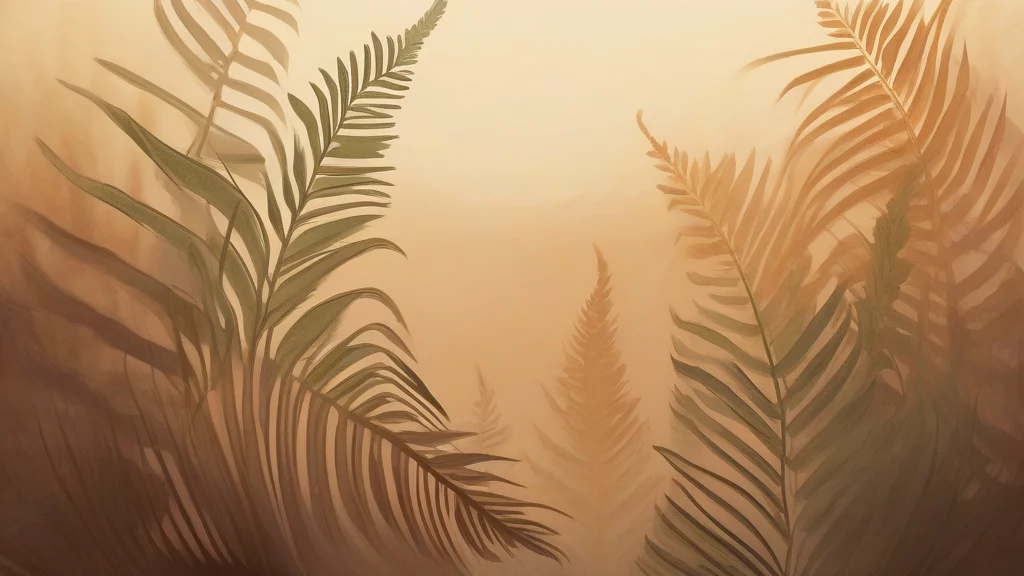
What does fernlike mean?
Fernlike is an adjective describing something that resembles a fern — particularly the plant's signature finely divided, feathery foliage. It is most commonly used in botany and natural-history writing to characterize leaves, fronds, or branching structures whose parts split repeatedly into delicate, lacy segments. Beyond plants, the word is applied wherever that intricate, feathered geometry shows up: frost etched on a window, the spread of a river delta from above, coral formations, or the filigree of certain minerals. The word carries connotations of delicacy, intricacy, and natural elegance, which makes it useful for evocative description as well as precise scientific comparison. Because it is simply the combination of "fern" and "-like," it is transparent in meaning and easy to deploy, yet specific enough to sharpen any description of feathery, divided forms in the natural world.
adjectiveResembling a fern in appearance, structure, or form, especially in having finely divided, feathery fronds or branches.
- Resembling a fern in shape or texture, especially with finely divided, feathery parts.
"The frost traced fernlike patterns across the windowpane overnight."
"The fossil preserved a fernlike imprint of the ancient plant's leaves."
"Lacy curtains cast fernlike shadows on the sunlit floor."
The same fernlike branching pattern appears in frost on glass, river deltas seen from space, and even lightning bolts — nature reuses its favorite design everywhere.
Reviewed by Deb Chak, Editor. AI-assisted content curated by RJS Tech Solutions LLP.
Etymology of fernlike
Fernlike is formed by straightforward English derivation: the noun "fern," from Old English "fearn," combined with the adjectival suffix "-like." The Old English word traces back through Germanic sources, with cognates in other Germanic languages such as Dutch "varen" and German "Farn." As a compound, fernlike arose much later in English, following the productive pattern of "-like" compounds (such as childlike and lifelike) that has been common in the language since Middle English times.
How fernlike is actually used
A descriptive adjective most often found in botanical, scientific, and nature writing, though it appears freely in general prose to evoke delicacy and intricacy. It is typically used attributively ("fernlike fronds") but can also function predicatively ("the patterns were fernlike").
Easily confused with fernlike
"Ferny" means abounding in ferns or characteristic of ferns, while "fernlike" specifically describes something that resembles a fern's shape or structure.