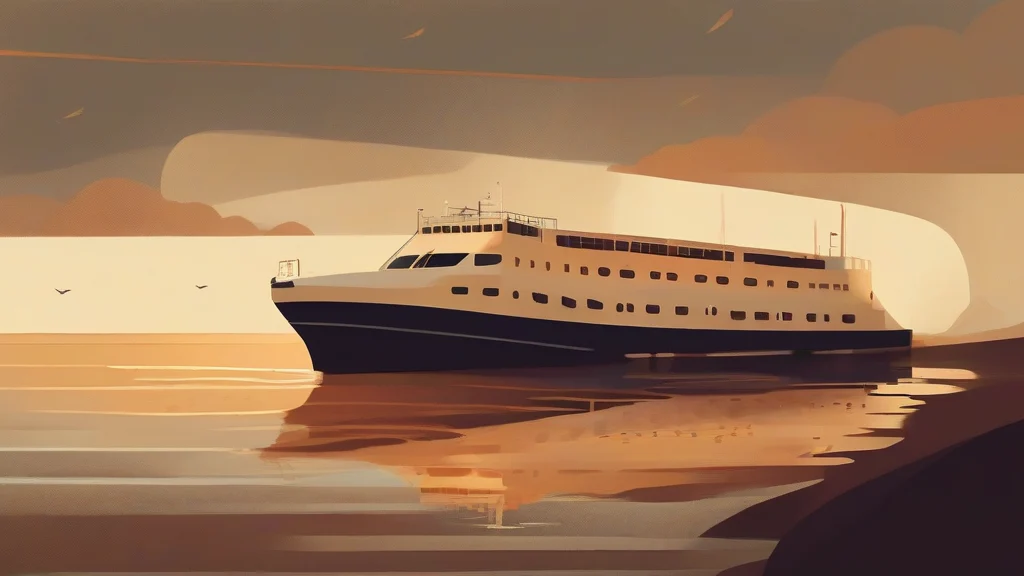
What does ferry mean?
A ferry is a vessel that carries passengers — often with their cars, bicycles, or cargo — across a river, bay, or strait on a regular, scheduled route. The word also works as a verb: to ferry someone or something is to transport it across water, and by extension, to shuttle it back and forth over any short distance. This extended use is now firmly established in everyday English; buses can ferry commuters, aircraft can ferry supplies, and parents famously ferry children between activities. The term carries no emotional coloring — it is practical, neutral, and universally understood in both British and American usage. Ferries are among the oldest forms of organized public transport, predating bridges and tunnels wherever water barriers had to be crossed, and they remain vital links for islands, coastal cities, and riverside communities around the world. Few words so neatly connect ancient travel traditions with modern commuting.
A boat or ship that transports passengers, and sometimes vehicles and cargo, across a body of water on a regular route.
"The ferry to Nantucket departs from Hyannis every hour."
The plural is 'ferries'; note the change from -y to -ies.
To transport people or things by boat across a body of water, or more generally to convey them back and forth over a short distance.
"Helicopters ferried rescue workers up the mountainside."
The -y changes to -ies in the plural, following standard English orthography.
"Several ferries cross the harbor each day."
The word 'ferry' shares an ancient root with 'fare' — the same Germanic verb that once meant simply 'to travel' now powers everything from Staten Island ferries to airport shuttle runs.
Reviewed by Deb Chak, Editor. AI-assisted content curated by RJS Tech Solutions LLP.
Etymology of ferry
Ferry comes from the Old English verb 'ferian', meaning to carry, convey, or travel, which derives from the Germanic root '*far-', the same source as 'fare' and 'go' (via related Germanic forms). The noun originally denoted the passage across the water itself before shifting to mean the vessel that made the crossing, and the verb's modern figurative use of shuttling things short distances developed naturally from its core sense of conveying. Cognates appear throughout the Germanic languages, and the root ultimately connects to Latin 'peregrinari', meaning to travel abroad, which gives English 'pilgrim' and 'peregrine'.
Related word forms
How ferry is actually used
Both noun and verb senses are neutral in register and common in everyday speech worldwide. The verb sense has broadened figuratively: anything that repeatedly transports people or items a short distance can be said to 'ferry' them, including aircraft, buses, and even hands passing dishes at a table. In aviation, 'ferry flight' specifically means flying an aircraft from one location to another without passengers, such as for delivery or repair.
Easily confused with ferry
'Bury' means to place something underground or hide it, while 'ferry' refers to carrying people or goods across water (or shuttling them short distances).