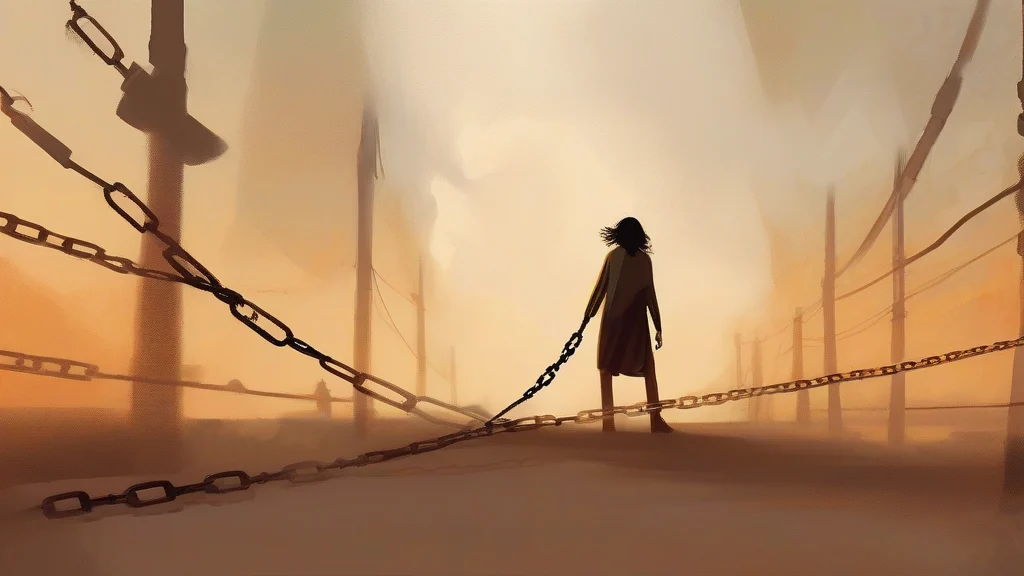
What does fettered mean?
Fettered means bound or restrained, whether literally with chains or figuratively by forces that limit freedom. The word derives from 'fetter', an old English term for a shackle fastened around the ankle, and retains that physical imagery even in its most common modern use: describing people, institutions, or ideas held back by constraints. A writer may feel fettered by a deadline, a government fettered by constitutional limits, or a business fettered by red tape. The word carries a formal, often literary tone and tends to imply that the restraint is unwelcome or unjust. Its antonym, 'unfettered', is arguably more frequently used today, particularly in discussions of free markets or unrestricted access. Understanding 'fettered' enriches both reading and writing, as it condenses the idea of being weighed down or confined into a single vivid word rooted in centuries of physical and metaphorical bondage.
Past tense and past participle of fetter: to restrain with chains or shackles, or figuratively to restrict the freedom of someone or something.
"His hands were fettered during the transfer between prisons."
Often used in passive constructions, especially in the figurative sense ('fettered by', 'fettered to').
Bound or constrained, especially by obligations, fears, or conventions that limit freedom.
"She refused to live a fettered existence, bound by other people's expectations."
Usually appears attributively or predicatively with a following 'by' phrase specifying the source of constraint.
The same iron rings that once bound prisoners' ankles now bind imaginations — 'fettered' has been chaining minds metaphorically since the Middle Ages.
Reviewed by Deb Chak, Editor. AI-assisted content curated by RJS Tech Solutions LLP.
Etymology of fettered
Fettered comes from the Old English noun 'feter', meaning a chain or shackle for the feet, which traces back to Proto-Germanic roots; cognates appear in Old Saxon 'feteros' and Old High German 'fezzar', with related forms across other Germanic languages. The verb 'to fetter' developed from the noun in Old English itself, so both the binding device and the act of restraining are native to English rather than borrowed. The figurative sense of restraining freedom of thought or action emerged early through metaphorical extension and remains the dominant usage today.
Related word forms
How fettered is actually used
Mostly literary or formal in modern usage; the literal sense (physical shackle) is now rare outside historical writing. The negative form 'unfettered' is considerably more common than 'fettered' itself, especially in political and economic contexts such as 'unfettered access'.
Easily confused with fettered
Despite a faint sound similarity in some accents, futile means incapable of producing any useful result, whereas fettered means restrained or hampered.