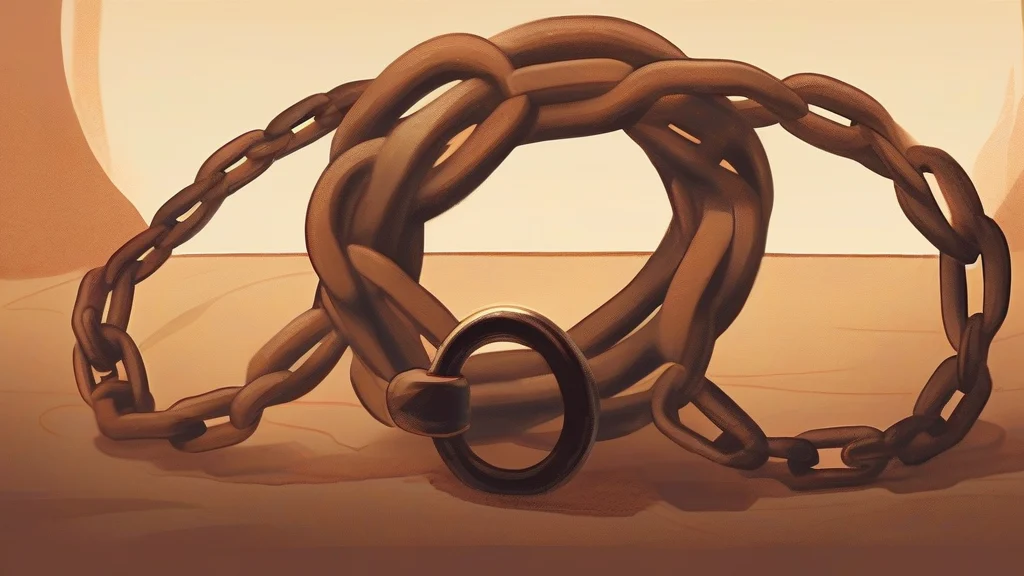
What does fetter mean?
A fetter is, in its most concrete sense, a chain or shackle fastened around the ankles to restrain a prisoner — an image familiar from histories of dungeons and convict ships. By extension, the word has come to describe any constraint on liberty, whether imposed from outside or accepted willingly: the fetters of tradition, debt, censorship, or fear. As a verb, to fetter is to bind or hamper in this way, so that we speak of innovation fettered by regulation or creativity fettered by routine. The word carries strongly negative connotations of oppression and lost freedom, which makes it a favorite of political and moral rhetoric, often appearing alongside 'cast off', 'throw off', or 'shake free of'. Though somewhat literary in tone, it remains vivid and current, especially in the form 'unfettered'. Rooted in Old English, fetter connects English speakers to a vocabulary of restraint shared across centuries of writing about power and liberty.
A chain or shackle for the ankles or feet used to restrain a prisoner; more broadly, any thing or influence that confines or restricts freedom of action.
"He walked the long corridor with difficulty, the heavy fetters chafing his ankles."
Usually plural when referring to physical restraints; singular is common in figurative use ('a fetter upon the mind').
To bind the feet with chains or shackles; figuratively, to restrict, hinder, or constrain someone or something.
"Excessive licensing rules fetter the growth of small businesses."
The plural is standard when referring to physical restraints, typically one per leg. The figurative sense may take either singular or plural form.
"The guards struck off the prisoner's fetters and set him free."
The same Germanic root that gave us 'fetters' also gave us 'fetlock' — the tuft of hair above a horse's hoof — because both literally sit at the foot.
Reviewed by Deb Chak, Editor. AI-assisted content curated by RJS Tech Solutions LLP.
Etymology of fetter
Fetter derives from Old English 'feter', meaning a chain for the feet, from Proto-Germanic '*fetrō', formed on the root '*ped-' meaning foot — the same Indo-European root behind Latin 'pes' and Greek 'pous'. This kinship makes fetter cognate not only with words like 'foot' and 'pedal' but, through Latin, with 'impede' (literally to catch someone by the foot) and 'expedite'. The word has kept its core sense of foot-restraint essentially unchanged since before the Norman Conquest, while acquiring its figurative use over time.
Related word forms
How fetter is actually used
Fetter is largely literary and formal today; literal physical fetters are mostly encountered in historical contexts, while figurative uses (the fetters of debt, tradition, or bureaucracy) remain common in journalism and political rhetoric. The adjective 'unfettered', meaning unrestrained, is by far the most frequent modern form.
Easily confused with fetter
Fettle means to line or repair (as a furnace) or to be in good condition ('in fine fettle'), whereas fetter refers to restraining with chains.