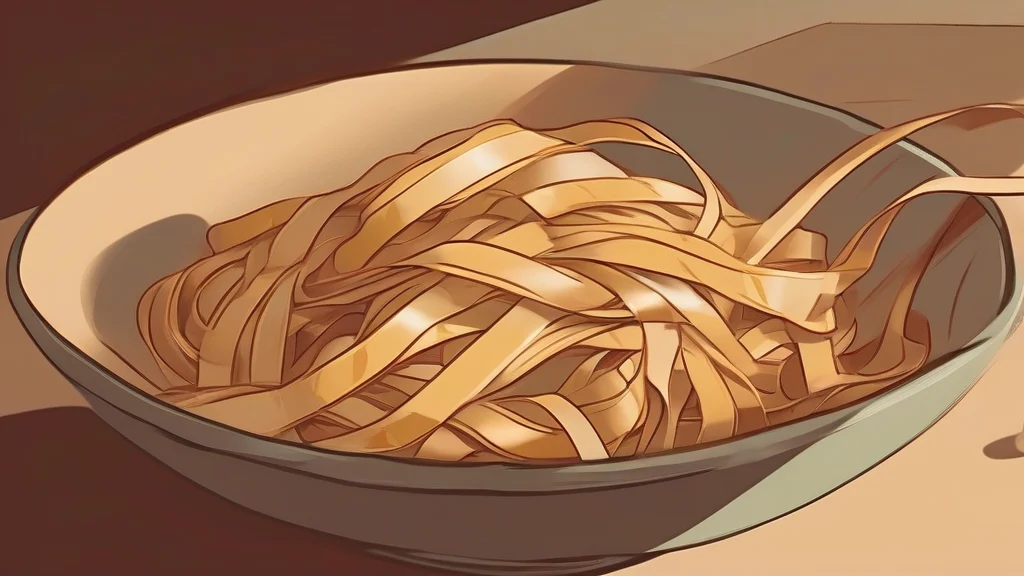
What does fettuccine mean?
Fettuccine is a variety of Italian pasta cut into long, flat, relatively thick ribbons, a form the Italians describe as 'little ribbons,' the literal meaning of the word. It is one of the most familiar ribbon-shaped pastas outside Italy, especially in the United States and Britain, where it anchors classic dishes such as fettuccine Alfredo — wide strands coated in butter, cream, and Parmesan cheese. Its broad surface makes it well suited to rich, creamy sauces, which cling to the wide ribbon, while lighter oil-based sauces are more often paired with thinner pastas like linguine. Fettuccine is sold dried in supermarkets everywhere, but fresh versions, made with egg-enriched dough, are prized for their softer texture and quicker cooking time. In everyday English the word functions as an uncountable noun describing both the dry product and the prepared dish.
nounFettuccine is a type of pasta in the form of long, flat, thick ribbons, popular in Italian and Italian-American cooking.
- A variety of pasta made in long, flat, thick ribbons, typically about a quarter of an inch wide.
"She tossed the fresh fettuccine with butter, cream, and shaved Parmesan."
"The trattoria serves its fettuccine with a slow-simmered Bolognese ragù."
"Homemade fettuccine needs only flour, eggs, and a rolling pin."
In ordinary use fettuccine is treated as uncountable and keeps the same form for plural reference. The anglicized plural 'fettuccines' occurs occasionally, chiefly when referring to multiple varieties or servings.
"The market sells several fresh fettuccine flavored with spinach, tomato, or squid ink."
The name literally means 'little ribbons' in Italian — each strand of fettuccine is a tiny strip of silk for your sauce.
Reviewed by Deb Chak, Editor. AI-assisted content curated by RJS Tech Solutions LLP.
Etymology of fettuccine
Fettuccine comes from the Italian 'fettuccia,' meaning 'little ribbon' or 'small band,' a diminutive of 'fetta,' meaning 'slice' or 'strip.' The Italian word ultimately traces back through Latin 'fascia,' a band or wrapping cloth — the same Latin root that gives English 'fascia' and, by way of the bundle of rods called the 'fasces,' words like 'fascism.' The pasta name entered English in the nineteenth and early twentieth centuries as Italian cuisine spread internationally.
How fettuccine is actually used
In English usage the word is usually treated as a mass noun referring to the pasta as served, so it commonly appears without an article ('a bowl of fettuccine'). It is strongly associated with Roman cuisine, notably fettuccine Alfredo, though that dish itself was popularized largely by Italian-American restaurants.
Easily confused with fettuccine
Linguine is a long pasta that is narrower and more elliptical in cross-section than the broad, flat ribbons of fettuccine.
Tagliatelle is the closely related northern Italian ribbon pasta, typically slightly thinner and narrower than fettuccine.