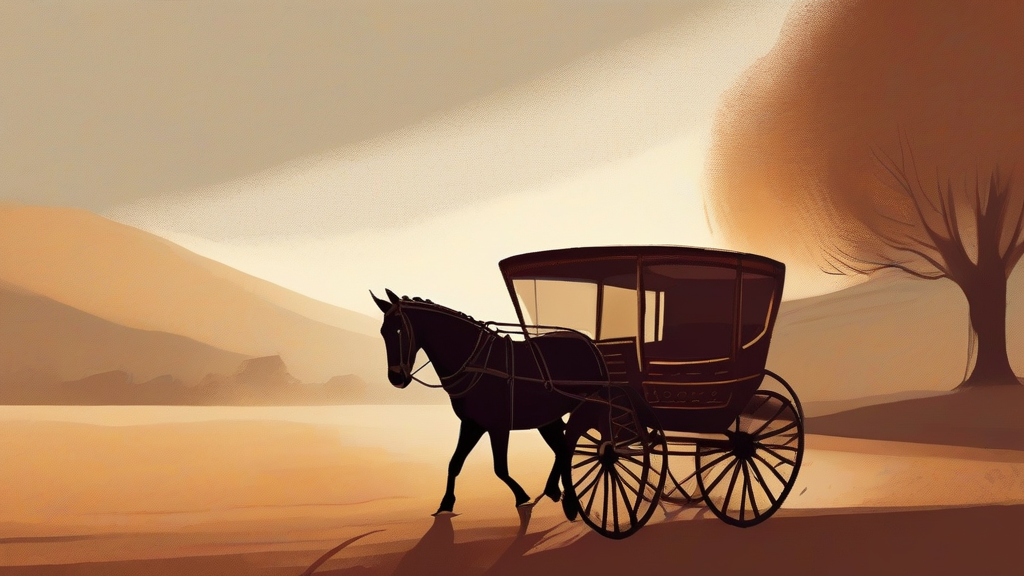
What does fiacre mean?
A fiacre is a small horse-drawn carriage kept for public hire, essentially the taxi of its day. The vehicle takes its name from the Hôtel de Saint-Fiacre in Paris, where such carriages were first let out for hire in the seventeenth century; the hotel was named for Saint Fiacre, an Irish-born saint whose image appeared on the carriages. Fiacres became a fixture of urban life in Paris and other European cities through the nineteenth century, plying the streets for passengers much as cabs do today. The word survives mainly in historical and literary writing, where it lends period flavour to descriptions of city life before the automobile. Because it denotes a specific kind of hire carriage rather than any cart or coach, it is best reserved for contexts set in, or describing, the age of horse-drawn transport.
nounA small horse-drawn carriage for hire, formerly common in Paris and other cities; the word is a historical term for what would now be called a taxi.
- A small horse-drawn carriage kept for public hire, especially one used in France from the 17th century onward.
"She hailed a fiacre outside the theatre and gave the driver her address on the Rue de Rivoli."
"The streets of nineteenth-century Paris were clogged with fiacres jostling for fares."
"Rather than walk home in the rain, he took a fiacre from the corner of the boulevard."
Standard English plural; the final -e is retained and -s added.
"By noon, a line of impatient fiacres had formed outside the station."
The word 'fiacre' comes from a Parisian hotel named after an Irish saint whose picture was painted on the first carriages for hire — making him history's most unlikely taxi mascot.
Reviewed by Deb Chak, Editor. AI-assisted content curated by RJS Tech Solutions LLP.
Etymology of fiacre
The word 'fiacre' derives from the Hôtel de Saint-Fiacre in Paris, at which horse-drawn carriages were first offered for hire in the early seventeenth century; carriages bearing the image of the hotel's patron saint came to be known by his name. Saint Fiacre himself was an Irish or Scottish missionary who settled in France in the seventh century, his name ultimately stemming from the Gaelic personal name Fiachra. The term passed into English in the seventeenth century and was later echoed by other languages, including German, which adopted 'Fiaker' for the famous hire carriages of Vienna.
How fiacre is actually used
The word is now largely historical and literary, evoking the era before motor taxis; it carries an old-fashioned, picturesque connotation. In French it remained the everyday word for a hired cab into the twentieth century.
Easily confused with fiacre
A fiacre is a horse-drawn hire carriage, while a fiasco is a complete failure or disaster; the words merely look and sound similar.