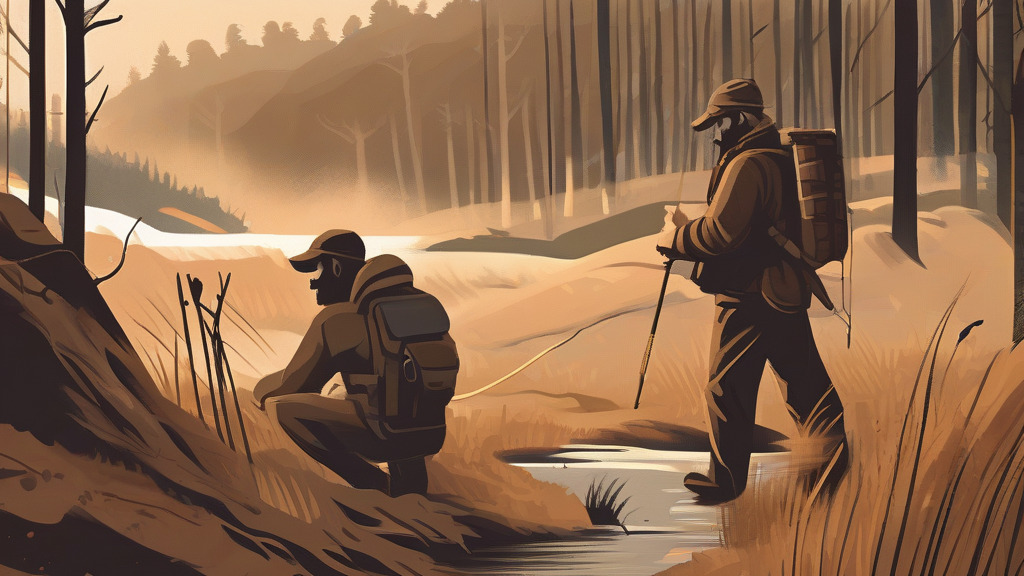
What does fieldcraft mean?
Fieldcraft denotes the body of practical skills needed to live, move, and operate effectively in open country. It embraces camouflage and concealment, silent movement, careful observation, navigation across unfamiliar terrain, and a working knowledge of weather, vegetation, and animal behaviour. The term is most strongly associated with military life, where soldiers are drilled in fieldcraft so that they can approach objectives unseen and survive away from base, but it applies equally to the naturalist who reads a hedgerow, the hunter who stalks game, and the scout who navigates by the land itself. Used as an uncountable noun, it typically appears in phrases such as 'good fieldcraft' or 'basic fieldcraft', and its connotations are those of quiet, practical competence rather than classroom theory. It is a useful word precisely because no single synonym captures this blend of outdoor skill, situational awareness, and self-reliance.
nounThe skill and knowledge required to work or survive effectively in open country or in the field, encompassing observation, camouflage, movement, and an understanding of terrain and natural conditions. It is used especially of soldiers on operations, scouts, hunters, and naturalists studying wildlife.
- Skill in living, moving, and operating effectively outdoors or in the field, especially in military contexts (camouflage, concealment, observation, navigation).
- By extension, the practical outdoor expertise of naturalists, hunters, and scouts in observing wildlife and reading the countryside.
"Good fieldcraft allowed the patrol to move within a hundred metres of the enemy post undetected."
"The recruits spent their first week learning fieldcraft: how to move silently, use cover, and read the ground ahead."
"Her fieldcraft was so refined that she could sit motionless for hours and watch foxes at close range."
Rarely pluralised; the word is almost always used as an uncountable mass noun. A plural form exists only in unusual contexts referring to distinct varieties of the skill.
"Different environments demand different fieldcrafts, from desert tracking to Arctic survival."
In the military, fieldcraft is the quiet art of not being seen — the skills that let a soldier cross open ground without ever being spotted.
Reviewed by Deb Chak, Editor. AI-assisted content curated by RJS Tech Solutions LLP.
Etymology of fieldcraft
Fieldcraft is formed by straightforward English compounding: 'field', from Old English 'feld' meaning open or cultivated land, joined to 'craft', from Old English 'cræft', meaning skill, strength, or art. Both elements are Germanic in origin, making this an entirely native English formation rather than a borrowing. The compound belongs to a productive family of '-craft' words that pair a domain of activity with the skill practised in it, alongside woodcraft, handicraft, and statecraft, and it emerged in modern English usage as military training and outdoor pursuits formalised these disciplines.
How fieldcraft is actually used
The word carries a connotation of practical, hard-won competence rather than formal training, and it is most at home in military, scouting, hunting, and nature-study contexts. It functions as an uncountable mass noun in standard usage and is slightly more common in British English.
Easily confused with fieldcraft
Handicraft refers to skilled manual work making decorative or useful objects by hand, whereas fieldcraft refers to practical skill in operating and surviving in open country.