What does fingerboard mean?
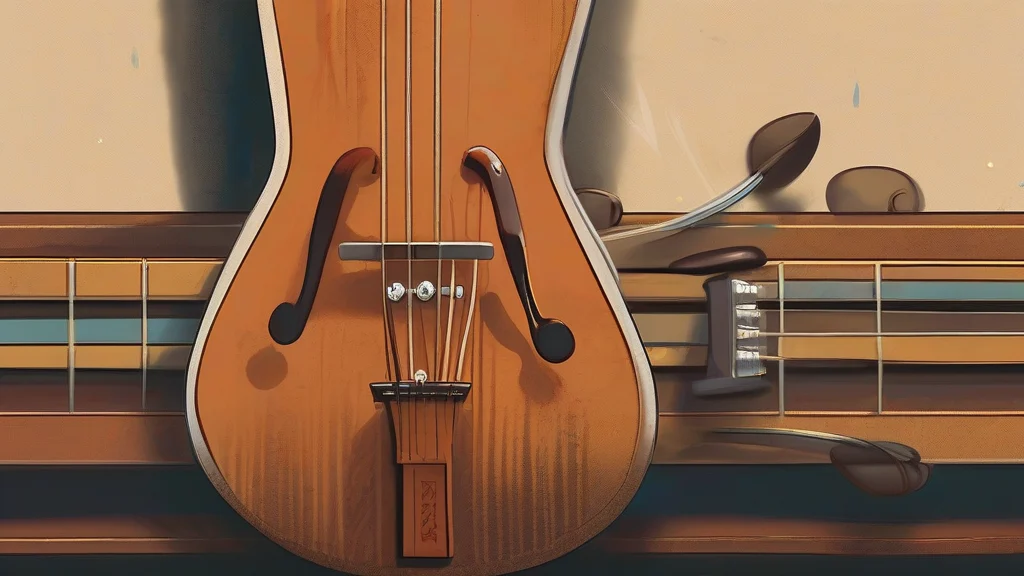
A fingerboard is the long, flat strip of wood — typically ebony, rosewood, or maple — that runs along the neck of a stringed instrument such as a violin, guitar, cello, or mandolin. Players press the strings down against it to shorten their vibrating length and thereby change pitch. On fretted instruments like the guitar, the fingerboard is fitted with metal frets, leading many players to call it a fretboard; on fretless instruments like the violin family, the smooth surface means players must place notes entirely by ear and touch, making the fingerboard central to technique and intonation. The word also names a miniature skateboard, usually around four inches long, manipulated with the fingers to perform tricks — a popular toy and collector's hobby since the late twentieth century. Whether in a concert hall or on a desktop, the term combines the everyday word 'finger' with 'board', reflecting its essential role: the surface where fingers meet strings or wheels.
The flat strip along the neck of a stringed instrument against which the strings are pressed to change pitch.
"The luthier replaced the worn ebony fingerboard on the old cello."
A miniature skateboard designed to be manipulated with the fingers.
"He spent the afternoon practising kickflips with his fingerboard on the desk."
Regular plural formation; used for both the musical sense and the toy sense.
"The shop stocked rosewood and ebony fingerboards for a range of instruments."
A violinist's fingerboard has no frets at all — every single note is found by feel alone.
Reviewed by Deb Chak, Editor. AI-assisted content curated by RJS Tech Solutions LLP.
Etymology of fingerboard
The word fingerboard is a straightforward English compound of 'finger' (from Old English 'finger') and 'board' (from Old English 'bord', meaning a plank or flat surface). It emerged in English usage by at least the seventeenth century as instrument-making vocabulary developed alongside the growing string-instrument tradition. Its transparent structure made it easy to extend metaphorically, and in the late twentieth century it was applied to miniature finger-operated skateboards. Cognate compounds appear in other Germanic languages, such as German 'Griffbrett', which conveys the same instrumental meaning.
How fingerboard is actually used
In musical contexts, 'fingerboard' is standard across classical and popular music; players of fretted instruments often say 'fretboard', but the two terms overlap heavily. The skateboarding sense arose in the late 20th century and is chiefly associated with toys and hobbyist culture.
Easily confused with fingerboard
Fretboard refers specifically to a fingerboard fitted with frets, as on a guitar, while 'fingerboard' is the broader term that also covers fretless instruments like the violin.