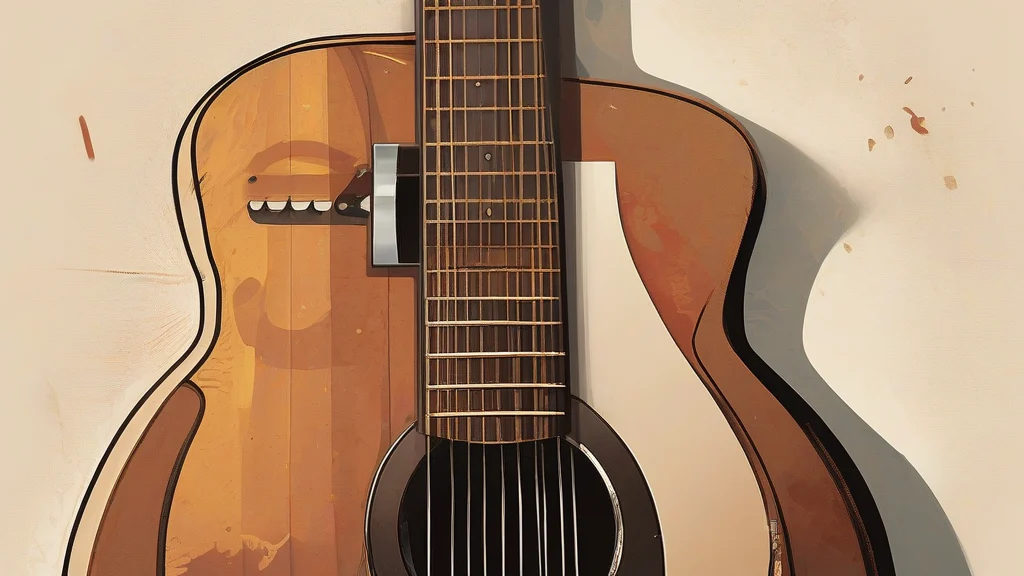
What does fretboard mean?
A fretboard is the long, narrow strip of wood—typically rosewood, maple, or ebony—that runs along the neck of a stringed instrument such as a guitar, bass, or mandolin. Set into its surface are thin metal bars called frets, which divide the board into precise segments; when a player presses a string down behind a fret, the vibrating length of the string shortens and the pitch rises accordingly. Learning the fretboard—knowing which note lies under each finger at every position—is one of the central skills of playing a fretted instrument, and countless diagrams, apps, and exercises exist to help players map it out. The word belongs mostly to the world of musicians and instrument makers, though it appears often in music journalism and instruction. It is closely related to 'fingerboard', a broader term covering both fretted and unfretted instruments; violins have a fingerboard but no fretboard, since players find pitches by ear rather than by fixed frets.
nounThe long strip of wood, usually with metal frets set into it, along the neck of a stringed instrument such as a guitar, on which the player presses the strings to change their pitch.
- The flat strip along the neck of a fretted stringed instrument (guitar, bass, mandolin) where metal frets are set and against which the strings are pressed to produce different pitches.
"She ran her fingers up the fretboard in a blistering guitar solo."
"He taped a diagram of the fretboard above his desk to memorize the note positions."
"The bassist's fingers moved effortlessly across the fretboard during the funk breakdown."
Standard plural; typically used when discussing multiple instruments or comparing different designs.
"Maple fretboards are prized for their bright tone and smooth finish."
Master musicians navigate the fretboard entirely by feel — in the dark, without ever looking down at a single note.
Reviewed by Deb Chak, Editor. AI-assisted content curated by RJS Tech Solutions LLP.
Etymology of fretboard
Fretboard is a straightforward compound of 'fret'—the metal bar on a stringed instrument, a word whose own musical origins trace back through older European languages—and 'board'. It emerged as instrument-making terminology alongside the modern guitar tradition, becoming widespread in English during the nineteenth and twentieth centuries as fretted instruments grew popular. Its sibling term 'fingerboard' predates it and remains the more general word for the strip on any stringed instrument's neck.
How fretboard is actually used
A technical term used mainly by musicians, teachers, and writers on music rather than in everyday conversation. In strict lutherie vocabulary, 'fretboard' and 'fingerboard' are sometimes distinguished (an unfretted fingerboard technically lacks frets), but in common usage among guitarists the two terms are often interchangeable.
Easily confused with fretboard
A fingerboard is the general term for the strip on any stringed instrument's neck, while a fretboard specifically refers to one fitted with frets, as on guitars and mandolins; unfretted instruments like violins have a fingerboard but no fretboard.