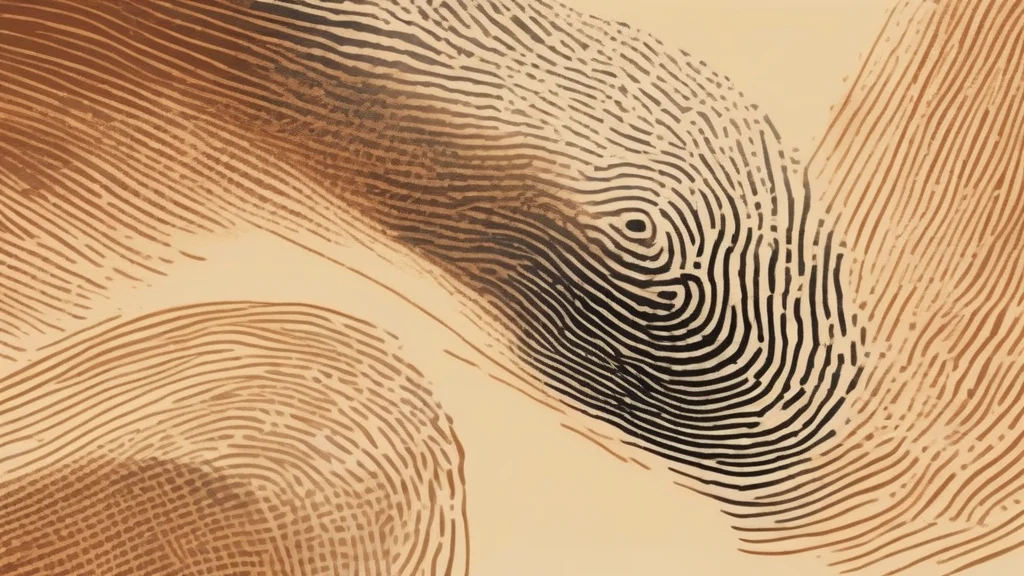
What does fingerprint mean?
A fingerprint is the characteristic pattern of ridges and valleys on the tip of a human finger, or the impression this pattern leaves when pressed against a surface. Because no two individuals — not even identical twins — share the same prints, fingerprints serve as one of the most reliable means of personal identification, and they have been central to forensic investigation since the late nineteenth century. Police investigators dust surfaces for prints, lift them with tape, and compare them against databases; governments routinely fingerprint visa applicants and arrestees. The word also extends figuratively: a piece of software, an artwork, or a criminal scheme may bear the 'fingerprints' of its creator, meaning it shows a distinctive, identifiable trace of their involvement. As a verb, to fingerprint means to record a person's prints, typically by inking or scanning the fingers. The word carries neutral, technical connotations, though its figurative uses can suggest evidence of guilt or authorship.
An impression or mark left on a surface by the friction ridges on a fingertip, unique to each individual and used as a means of identification.
"Forensic technicians recovered a clear fingerprint from the doorknob."
Commonly used in both literal forensic contexts and figurative senses indicating a distinctive trace.
To record the fingerprints of a person, typically for official identification purposes.
"All new employees are fingerprinted as part of the background check."
Standard regular plural. Often used collectively, as in 'dust for fingerprints'.
"The burglar wore gloves so he wouldn't leave any fingerprints."
Your fingerprint forms before you are born and never changes — even identical twins, who share DNA, have entirely different prints.
Reviewed by Deb Chak, Editor. AI-assisted content curated by RJS Tech Solutions LLP.
Etymology of fingerprint
The word fingerprint is a straightforward English compound of 'finger', from Old English 'finger', and 'print', from Old French 'preinte', derived from Latin 'premere' (to press). The compound arose in the nineteenth century alongside the scientific study of skin-ridge patterns, gaining widespread use after Sir Francis Galton's research established fingerprint identification as forensic method in the 1890s. Related compounds such as footprint and thumbprint follow the same pattern of combining a body part with the pressing-derived noun 'print'.
Related word forms
How fingerprint is actually used
Neutral register across formal and informal contexts. The figurative sense ('the fingerprints of X') is common in journalism. As a verb, 'to fingerprint someone' usually appears in passive form: 'He was fingerprinted at the police station.'
Easily confused with fingerprint
A fingerprint is the mark made by a finger's ridges, while a footprint is the impression left by a foot.