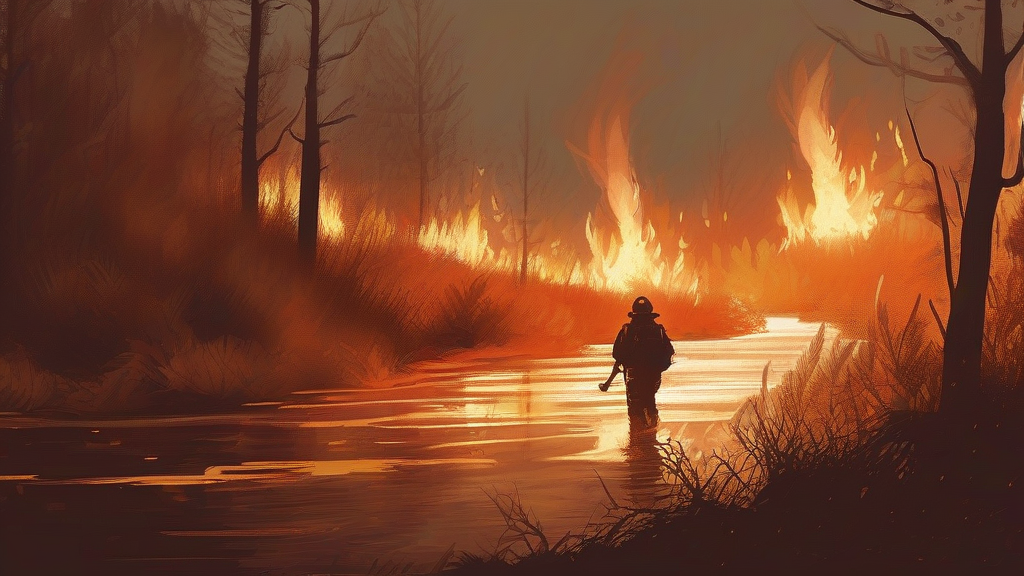
What does firebreak mean?
A firebreak is a strip of land deliberately cleared of trees, brush, and other flammable material so that an advancing wildfire has nothing left to burn when it reaches it. Firebreaks may be cut by bulldozers, ploughed by machine, or dug by hand, and they can also occur naturally in the form of rivers, roads, rocky ridges, or already-burned ground. The word belongs mainly to the vocabulary of forestry, firefighting, and rural land management, though it appears regularly in news reports about wildfires in places such as California, Australia, and southern Europe. Its connotations are practical and protective rather than emotional; it evokes preparation and containment rather than the fire itself. Figurative uses are rare but possible, as when journalists describe a policy or treaty as a "firebreak" against the spread of a crisis. Knowing the word is useful for anyone reading about wildfire response or discussing how fires are stopped before they reach homes and towns.
nounA strip of open land or cleared ground, from which flammable vegetation has been removed, that acts as a barrier to check the spread of a wildfire.
- A strip of land cleared of vegetation to halt or slow the spread of a wildfire.
- Any natural feature, such as a river or road, that serves the same fire-stopping function.
"Crews cut a wide firebreak along the ridge to stop the blaze from reaching the town."
"The logging road doubled as an effective firebreak when the forest fire swept toward the valley."
"Before the dry season, rangers burned off the undergrowth to widen the firebreak around the reserve."
Standard regular plural; used when referring to multiple cleared strips or barriers.
"The park maintains several firebreaks around its perimeter."
In 1910, firefighters in the American West dug firebreaks by hand through the night — and some survived the 'Big Burn' only by lighting their own backfires behind those lines.
Reviewed by Deb Chak, Editor. AI-assisted content curated by RJS Tech Solutions LLP.
Etymology of firebreak
"Firebreak" is a straightforward English compound, formed from the Old English nouns "fȳr" (fire) and the verb-derived noun "brecc/bryce" (a breaking), with "break" tracing back to Old English "brecan," meaning to break or shatter. Such compounds arose naturally in English-speaking farming and forestry communities to name a practical object: land broken clear of fuel to interrupt a fire's path. Cognates of both elements appear across the Germanic languages, including Dutch "vuur" and German "Feuer" for fire, and Dutch "breken" and German "brechen" for break. The word is modern enough that no elaborate historical development separates it from its transparent parts.
How firebreak is actually used
The word is neutral in register and appears chiefly in contexts of forestry, firefighting, land management, and news coverage of wildfires. In British English, "firebelt" occasionally appears as a variant, but "firebreak" remains standard on both sides of the Atlantic.
Easily confused with firebreak
A fireguard is often a barrier or screen protecting against fire (or the British term for a similar cleared strip), whereas a firebreak specifically denotes cleared land that halts a spreading wildfire.
A firewall is a physical fire-resistant wall within a building or, figuratively, a digital security system, while a firebreak is an open strip of land in rural or wild terrain.