What does firebrick mean?
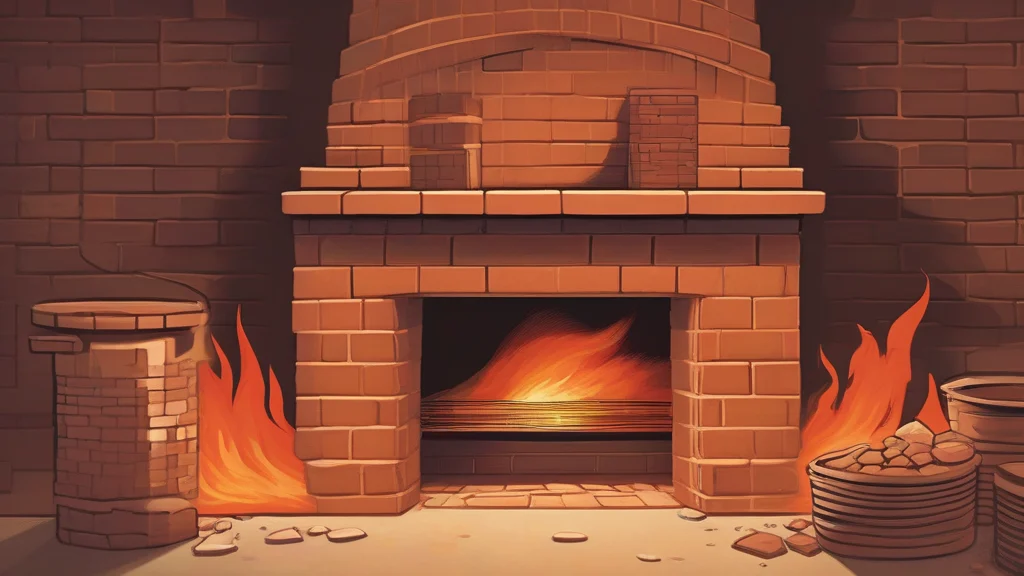
A firebrick is a dense, heat-resistant block manufactured from refractory materials such as fireclay, designed to endure extreme temperatures without melting, cracking, or degrading. Unlike ordinary building bricks, firebricks are formulated to tolerate thermal shock and prolonged exposure to flames, making them essential wherever intense heat is a working condition: furnaces, kilns, boilers, forges, chimneys, and fireplace linings all depend on them. The word functions as a noun in English and appears frequently both on its own ('lay the firebrick carefully') and as an attributive modifier ('a firebrick arch'). Because it belongs largely to the vocabulary of masonry, metallurgy, ceramics, and industry, its connotations are practical and technical rather than literary, yet it carries an evocative association with endurance — the quiet, unglamorous material standing between flame and structure. For anyone interested in how buildings and machines harness fire safely, firebrick is a small but indispensable piece of engineering vocabulary.
nounA block of heat-resistant ceramic material, typically made of fire clay, used for lining furnaces, kilns, fireplaces, and other structures exposed to high temperatures.
- A refractory ceramic block made to withstand very high temperatures, used to line furnaces, kilns, boilers, and fireplaces.
"The foundry's furnace was relined with fresh firebrick before the winter production run."
"The blacksmith rebuilt his forge using firebrick so the walls would survive repeated white-hot firing."
"Cracked firebrick in the boiler lining had to be replaced before the plant could safely restart."
Standard plural for referring to multiple individual blocks; the singular is used when speaking of the material collectively.
"The old kiln was dismantled and its scorched firebricks stacked aside for reuse."
Ordinary bricks would crack and crumble in a furnace — firebrick is engineered to shrug off temperatures well over 1,000°C, which is why every kiln and forge depends on it.
Reviewed by Deb Chak, Editor. AI-assisted content curated by RJS Tech Solutions LLP.
Etymology of firebrick
Firebrick is a straightforward English compound of 'fire' and 'brick', formed when the need arose for bricks capable of withstanding high temperatures in early industrial furnaces and kilns. The element 'fire' derives from Old English 'fȳr', of Germanic origin, while 'brick' came into Middle English from Old French 'brike', likely of Germanic descent. The compound emerged in the context of the developing metalworking and ceramics trades, probably in the seventeenth century or later, as specialized refractory manufacturing became established. Related formations such as 'fireclay' and 'fireplace' share the same productive use of 'fire' as a combining element.
Related word forms
How firebrick is actually used
Firebrick is primarily a technical and trades term, common in masonry, ceramics, metallurgy, and industrial contexts. It is usually an attributive noun (as in 'firebrick lining') and often appears as a count noun with the plural 'firebricks'.
Easily confused with firebrick
Fireclay is the raw heat-resistant clay material, while a firebrick is a finished brick made from fireclay and other refractory ingredients.