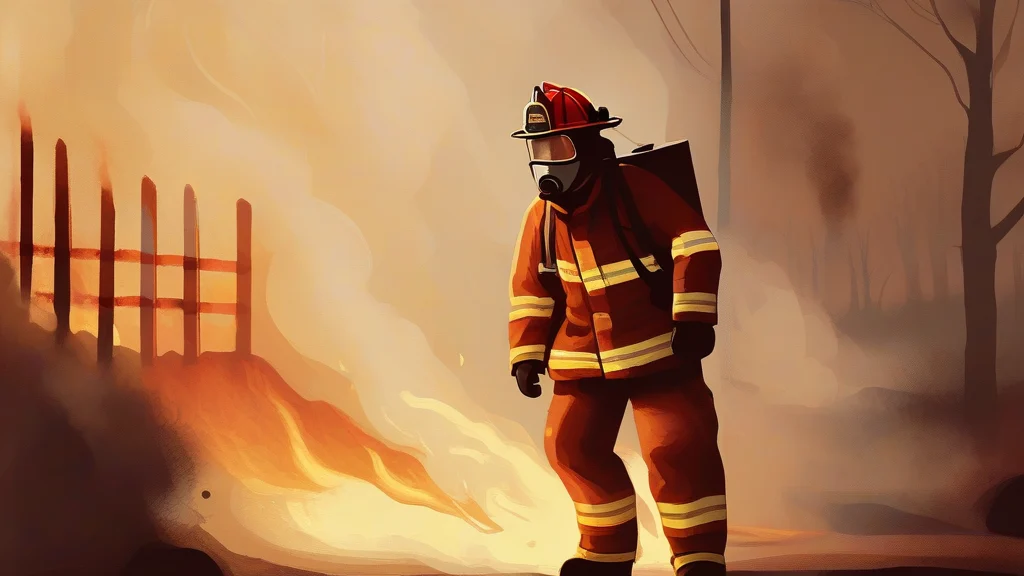
What does fireman mean?
A fireman is a person whose profession involves fighting fires, typically as a member of an organized fire department. Firemen respond to building fires, vehicle accidents, rescues, and other emergencies, often performing physically demanding and dangerous work under intense conditions. The word has traditionally been applied to male workers, which is why many fire services and dictionaries now favor the gender-neutral term 'firefighter'; nevertheless, 'fireman' remains widely used in casual speech, journalism, and popular culture, and it survives in fixed phrases such as the fireman's pole found on fire-station slides. A second, older sense refers to a worker who tended furnaces on steamships and locomotives, shoveling coal to keep engines running — a role that vanished with the decline of steam power. Connotations are strongly positive: courage, public service, and physical bravery. For learners of English, 'fireman' is easy to recognize but worth pairing with its modern counterpart to sound current and inclusive.
A member of a fire department whose job is to extinguish fires and respond to emergencies.
"The fireman was honored for saving three lives during the warehouse blaze."
Often written as 'firewoman' or more commonly 'firefighter' when referring to women.
A person responsible for tending the furnace or engine on a steamship or railway locomotive.
"The fireman spent his shift shoveling coal into the locomotive's firebox."
This industrial meaning is now largely historical.
Standard plural; note that the compound noun takes a regular plural form despite ending in 'man'.
"Three firemen were injured while battling the factory fire."
The word 'fireman' once described men who shoveled coal into blazing locomotive furnaces long before most people pictured anyone racing toward flames with a hose.
Reviewed by Deb Chak, Editor. AI-assisted content curated by RJS Tech Solutions LLP.
Etymology of fireman
Fireman is formed by straightforward English compounding of 'fire', from Old English 'fȳr' (of Germanic origin), and 'man'. It arose in the seventeenth century, when early uses referred to men who fired weapons or tended gunpowder — hence 'fire-master' and similar titles — before settling into its firefighting and stoker senses during the industrial age. Because it is an English compound rather than a borrowed word, it has no true cognates in other languages, though related English compounds such as 'fireplace' and 'fireproof' share the same first element.
Related word forms
How fireman is actually used
Increasingly replaced by 'firefighter' in official contexts because it is gender-neutral; 'fireman' remains common in informal speech and historical accounts. The railway/furnace sense is now largely historical in English-speaking countries.
Easily confused with fireman
'Firefighter' is the modern, gender-neutral professional term, while 'fireman' is an older term that traditionally implied a male worker.