
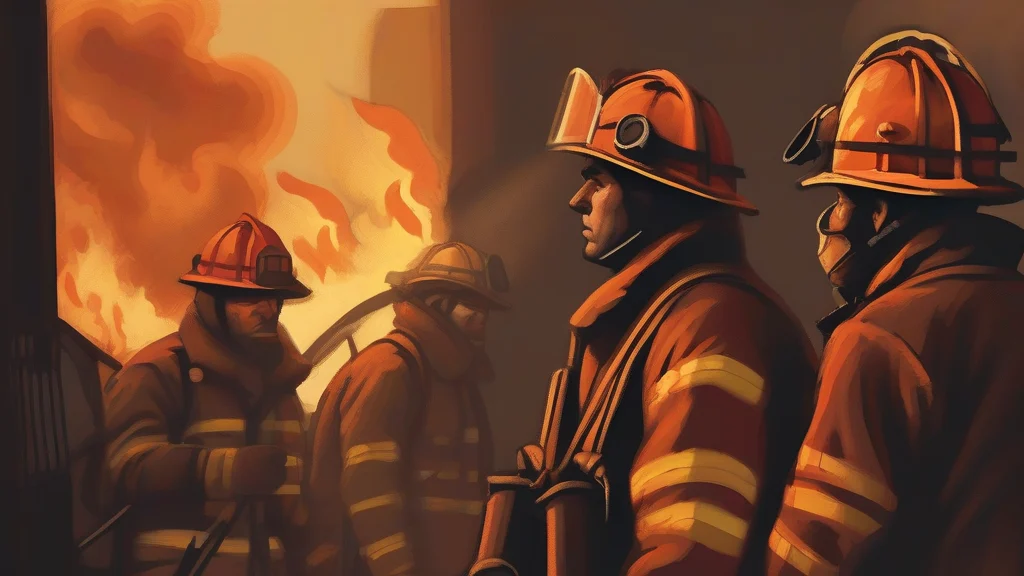
What does firemen mean?
'Firemen' is the plural of fireman, referring collectively to men whose profession is fighting fires and rescuing people from burning buildings. The word carries strong connotations of bravery and public service, evoking images of ladders, hoses, and daring rescues. In everyday speech it remains familiar, though modern usage has shifted decisively toward the gender-neutral 'firefighter', and official terminology in Britain, the United States, and elsewhere now reflects this change. The word has a second, older meaning: on steamships and railway locomotives, a 'fireman' was the crew member responsible for stoking the furnace that raised steam. This industrial sense survives mainly in historical writing and heritage railways. For general readers, 'firemen' is best understood as the traditional collective term for firefighting personnel — a word rich in history and heroism, even if contemporary language increasingly favours its modern successor.
Members of a fire department whose work is extinguishing fires and rescuing people; the plural of fireman.
"The firemen worked through the night to keep the wildfire away from the village."
Largely superseded by 'firefighters' in official and gender-neutral usage.
Men employed to tend the furnace or boiler of a steam engine on a ship or railway locomotive.
"As a young man he served as one of the firemen aboard transatlantic steamers."
A historical/industrial sense; rarely used outside historical contexts today.
'Firemen' is itself the plural form; the corresponding singular is 'fireman'. Modern fire services prefer the gender-neutral 'firefighters' over both.
"Three firemen were commended for their actions during the warehouse fire."
Before 'firemen' fought fires, many of them fed fires — shovelling coal into locomotive and ship furnaces at sea.
Reviewed by Deb Chak, Editor. AI-assisted content curated by RJS Tech Solutions LLP.
Etymology of firemen
The noun 'fireman' derives simply from the combination of 'fire', an ancient Germanic-rooted English word, and 'man'. It first emerged in English around the seventeenth century, originally denoting men who attended furnaces or artillery matches before evolving into its firefighting sense as organised fire brigades developed in the eighteenth and nineteenth centuries. Its compound structure parallels other 'fire-' combinations such as firearm and fireplace, while the plural 'firemen' follows standard English noun formation.
Related word forms
How firemen is actually used
'Firemen' is now considered somewhat dated and gender-specific in professional contexts; fire services overwhelmingly use 'firefighters'. The term persists in casual speech, historical accounts, and traditional phrases such as 'fireman's carry' and 'fireman's pole'.
Easily confused with firemen
A firefighter is simply the modern, gender-neutral term for the same role, whereas 'fireman' is the older form still used for men in the job and retained in phrases like 'fireman's pole'.
On steam locomotives and ships a 'fireman' was the crew member who tended the furnace, not someone who fought fires.