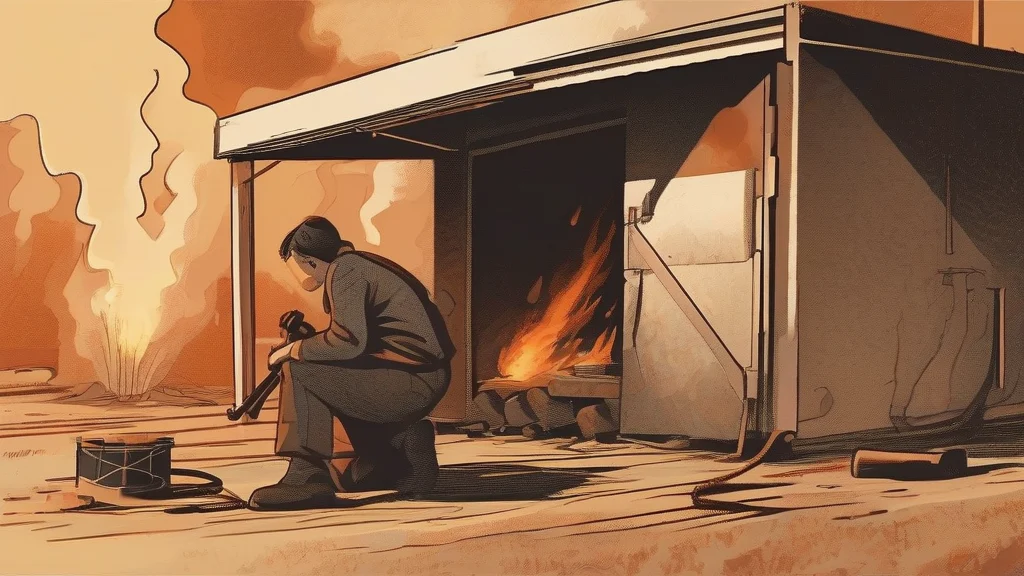
What does firing mean?
Firing is the noun formed from the verb 'fire', and it covers several distinct actions that share a single root concept: causing something to happen by igniting, discharging, or releasing. Most familiarly, firing means dismissing an employee — an act with strong negative connotations, often associated in headlines with layoffs, corporate restructuring, or public scandal. In other contexts, firing refers to discharging a weapon, as in gunfire or artillery; to hardening ceramics or bricks in a kiln; and to igniting an engine so that it begins running. The word is standard throughout the English-speaking world, though for job loss British speakers may favour 'sacking' or 'dismissal'. Its range makes it a useful word precisely because the same term links the workplace, the battlefield, and the potter's studio, all through the underlying image of something being set off or set alight.
An act of dismissing an employee; also the discharge of a weapon or the process of heating material in a kiln.
"Her firing came as a shock to everyone in the department."
When referring to job loss, the plural is rare and usually expressed as 'firings' only when discussing multiple dismissals.
Present participle of 'fire': to discharge a weapon, ignite an engine or kiln, or dismiss an employee.
"The manager is firing anyone who misses the deadline."
The plural 'firings' appears mainly in journalistic or official contexts describing multiple dismissals or multiple rounds of gunfire.
"A wave of executive firings followed the company's collapse."
In medieval times, a soldier who refused to shoot could face execution by his own side — which is exactly how the phrase 'firing squad' earned its chilling name.
Reviewed by Deb Chak, Editor. AI-assisted content curated by RJS Tech Solutions LLP.
Etymology of firing
Firing derives from 'fire', a word inherited from Old English 'fȳr', which traces back through Germanic languages to Proto-Germanic '*fūr', ultimately linked to Indo-European roots also seen in Greek 'pyr'. Originally tied strictly to combustion, the verb 'fire' broadened in Middle English and later acquired senses of shooting weapons (from matchlock firearms that were literally ignited), setting off engines, and dismissing employees — the last likely influenced by the American expression of someone being 'fired out' or discharged. Related words sharing the same ancient root include 'fiery' and compounds such as 'firearm' and 'kiln-fired' ceramics.
How firing is actually used
As a noun for job dismissal, 'firing' is common and slightly informal in American English; British English often prefers 'sacking' or 'dismissal', with 'firing' still widely understood. In contexts like pottery ('the firing of the kiln') or weaponry, it is neutral and standard in all varieties.
Easily confused with firing
Hiring means taking someone on as an employee, whereas firing means dismissing them from a job.