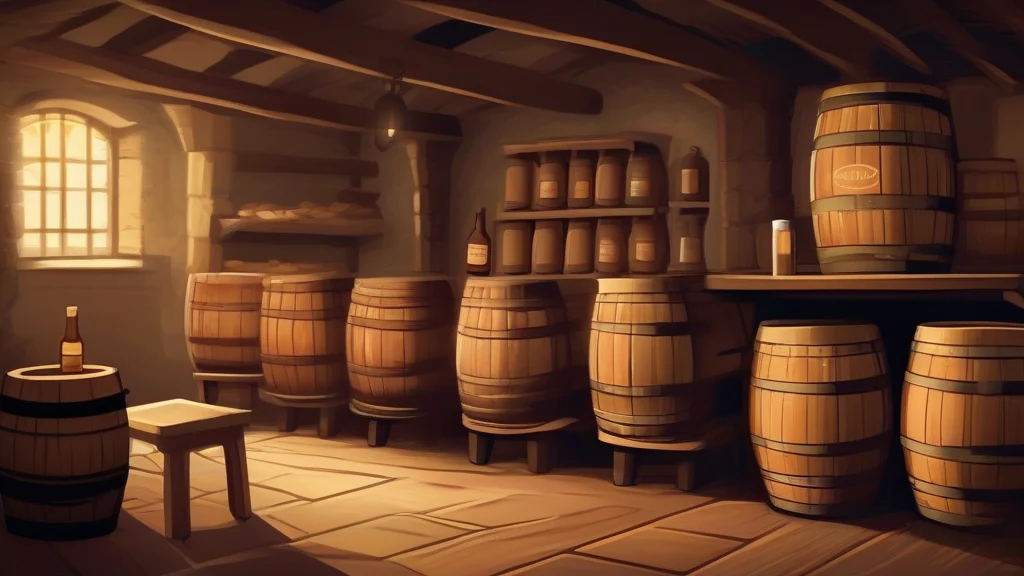
What does firkin mean?
A firkin is a small cask, historically made of wood and used to store and transport commodities such as butter, salted fish, soap, and above all ale. The word also functions as a unit of measurement whose value depended on the commodity: for beer or ale in Britain a firkin was a quarter of a barrel, or nine imperial gallons, while a firkin of butter was conventionally reckoned at fifty-six pounds. The term derives from Middle Dutch *vierdekijn*, meaning 'little fourth', reflecting its original definition as a quarter of a larger barrel. Although modern shipping long ago replaced the wooden firkin with steel kegs and standardized containers, the word survives in British real-ale culture, where small casks are still occasionally described as firkins, and in historical and museum contexts. For most English speakers today it is a quaint archival term rather than part of daily vocabulary, evoking pre-industrial trade, dairies, and taverns.
nounA small cask or barrel, historically used especially for butter, fish, or beer; in Britain it traditionally equals a quarter of a barrel (9 imperial gallons) for ale.
- A small wooden cask or barrel for liquids or provisions such as butter, fish, or beer.
- A (British) unit of capacity for ale equal to a quarter of a barrel, i.e. 9 imperial gallons; variously defined for other commodities such as butter (56 lb) or soap.
"The dairy shipped a firkin of butter to market every week."
"The brewer tapped the final firkin at the festival."
"Crocks and firkins of salted butter lined the cellar shelves."
Standard regular plural.
"The brewery delivered six firkins ahead of the bank holiday rush."
A firkin of ale is exactly nine gallons — a unit so beloved that British pub festivals still hold 'firkin' events celebrating real ale.
Reviewed by Deb Chak, Editor. AI-assisted content curated by RJS Tech Solutions LLP.
Etymology of firkin
Firkin comes from Middle Dutch *vierdekijn*, a diminutive of *vierde* ('fourth'), which itself derives from *vier* ('four'). It entered English in the late Middle Ages as the name for a small cask amounting to a quarter of a barrel. The same Dutch root lies behind its sense as a quarter-barrel measure of ale; beyond this lineage it has no widely known English cognates.
How firkin is actually used
The word is now largely historical or specialist, surviving mainly in brewing circles (especially CAMRA and real-ale contexts) and in discussions of traditional weights and measures. It carries an old-fashioned, rustic connotation.
Easily confused with firkin
A farthing is a small former British coin, while a firkin is a small cask; the two share only a vague sound resemblance.