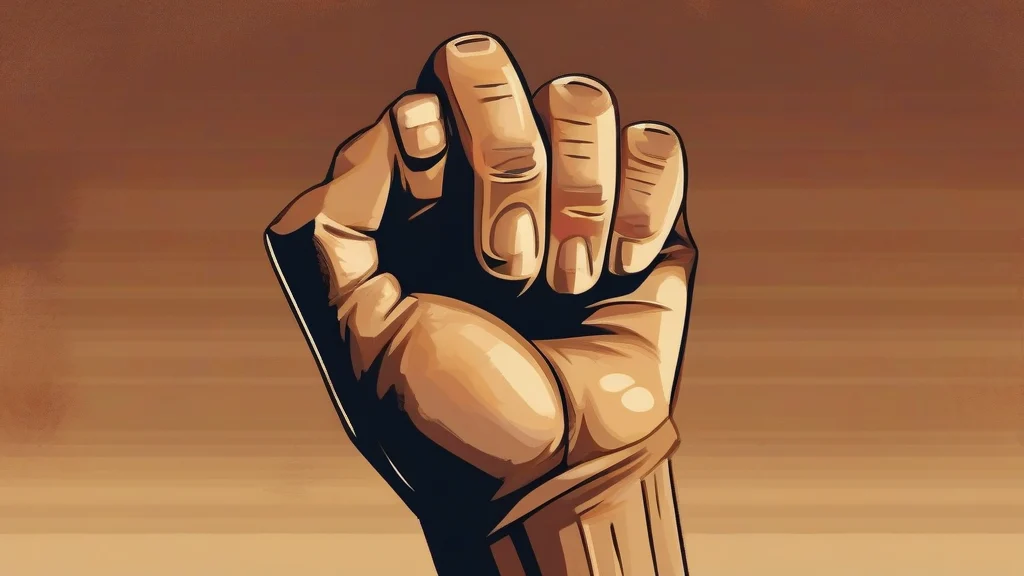
What does fist mean?
A fist is a hand clenched into a tight ball, formed when the fingers curl inward against the palm. It is among the most expressive gestures the human body can make: raised in defiance or solidarity, pounded on a table in fury, or extended in a friendly bump. In physical terms, the fist is also the instrument of a punch, giving the word strong associations with conflict, strength, and resistance. Common phrases reveal its cultural weight — "rule with an iron fist" evokes harsh authority, while "making money hand over fist" describes rapid profit. Beyond its literal sense, the word appears in compounds such as fistful and fistfight. Simple, vivid, and instantly understood, it remains a staple of both everyday conversation and political symbolism.
A hand with the fingers bent in tightly toward the palm so that it forms a compact ball.
"She held her ticket in her fist as the train pulled away."
Often used metaphorically to convey anger, control, or solidarity depending on context.
To strike with the clenched hand.
"He threatened to fist anyone who crossed the line."
This verb sense is uncommon and overlaps with a vulgar slang usage; prefer clearer phrasing in polite writing.
Standard regular plural.
"Both boxers raised their fists before the opening bell."
The phrase "making money hand over fist" comes from an old image of hauling in a rope so fast that one hand passes over the other — each grip a closed fist.
Reviewed by Deb Chak, Editor. AI-assisted content curated by RJS Tech Solutions LLP.
Etymology of fist
"Fist" derives from Old English "fȳst", which traces back to Proto-Germanic. It has direct cognates in other Germanic languages, notably German "Faust" and Dutch "vuist", all descending from the same ancestral root. Unlike many common nouns, it was not borrowed from Latin or French, making it a genuinely native Germanic survival in modern English.
Related word forms
How fist is actually used
"Fist" is neutral register and common in everyday speech. It frequently carries connotations of anger, defiance, solidarity (as in a raised fist), or physical force. As a verb, "to fist" exists meaning to strike with the fist, but it also has a crude slang sexual meaning, so writers should use it with care.
Easily confused with fist
"First" means preceding all others in order, while "fist" is the clenched hand — the two differ by only a single letter but are entirely unrelated in meaning.