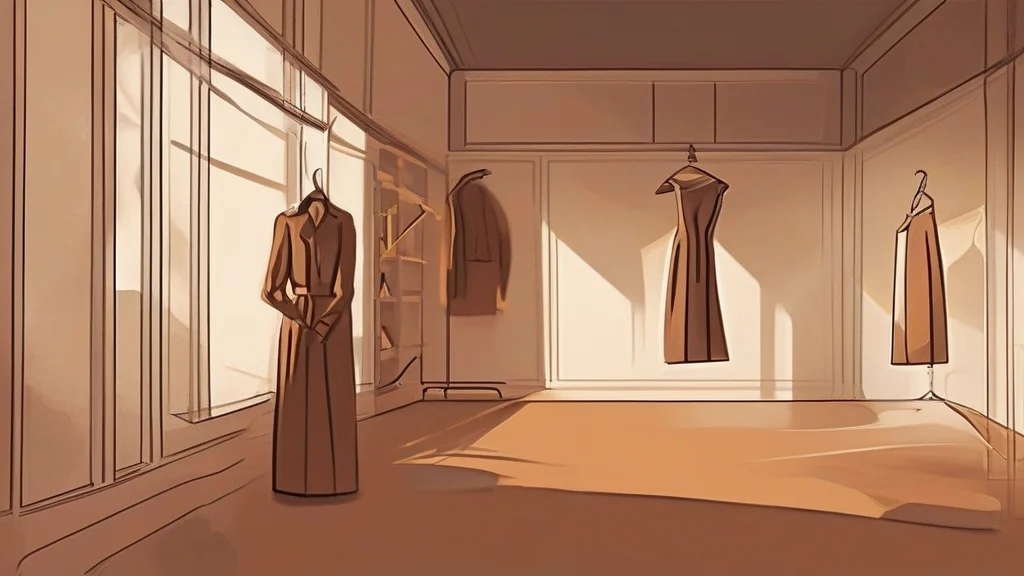
What does fitted mean?
'Fitted' functions both as an adjective and as the past tense and past participle of the verb 'fit'. As an adjective, it describes things made or shaped to conform precisely to a form — most often clothing cut to follow the lines of the body, but also fixtures permanently built into a building, such as fitted wardrobes, kitchens, or carpets. In this sense it conveys precision, craftsmanship, and tailoring quality: a fitted garment suggests careful construction rather than loose comfort. As a verb form, 'fitted' means installed or equipped, as when an engineer fitted a new lock to a door. Usage differs by region: British English treats 'fitted' as the standard past form of 'fit', while American English commonly uses 'fit' instead. The word appears frequently in everyday contexts — retail, home improvement, fashion — making it a practical term for describing anything custom-shaped or securely installed.
Made or shaped to conform closely to the shape of something, especially clothing tailored to the body; also used for fixtures built in permanently as part of a room or building.
"He chose a fitted shirt over a looser cut for the interview."
Very common in compounds like 'fitted sheet', 'fitted kitchen', and 'fitted wardrobe'.
Past tense and past participle of 'fit': to have installed, attached, or adjusted something so that it is correctly placed or sized.
"The mechanic fitted new brake pads to the car."
Standard in British English; American English typically uses 'fit' instead.
In British English, the tailor 'fitted' your suit yesterday — but in American English, he just 'fit' it, one of the quiet transatlantic divides hiding in plain sight.
Reviewed by Deb Chak, Editor. AI-assisted content curated by RJS Tech Solutions LLP.
Etymology of fitted
The word 'fitted' derives from the verb 'fit', which appeared in English in the mid-16th century, likely of Middle Dutch or Low German origin (related to words meaning 'to fix' or 'to adjust'). The past participle form developed naturally alongside the verb as its use expanded from general suitability into the specific sense of tailoring garments to measurements during the 17th and 18th centuries. Its cognates are found mainly in other Germanic languages rather than in Latin or Greek roots, reflecting the word's Germanic pedigree.
Related word forms
How fitted is actually used
As an adjective, 'fitted' is neutral in register and common in interior design, fashion, and retail contexts ('a fitted dress', 'a fitted sheet'). In British English, 'fitted' is the standard past form of the verb 'fit'; American usage increasingly prefers 'fit', so 'fitted' can read as slightly formal or British to US ears. The adjective should not be confused with the verb's simple past when used attributively — 'a fitted kitchen' is always adjectival.
Easily confused with fitted
'Fitting' is the present participle or a noun meaning a small component or the act of trying on clothes, whereas 'fitted' is the past participle or adjective describing something already made to fit.
British English conventionally uses 'fitted' as the past tense of 'fit' (e.g. 'the tailor fitted the suit'), while American English often uses plain 'fit'.