What does flagon mean?
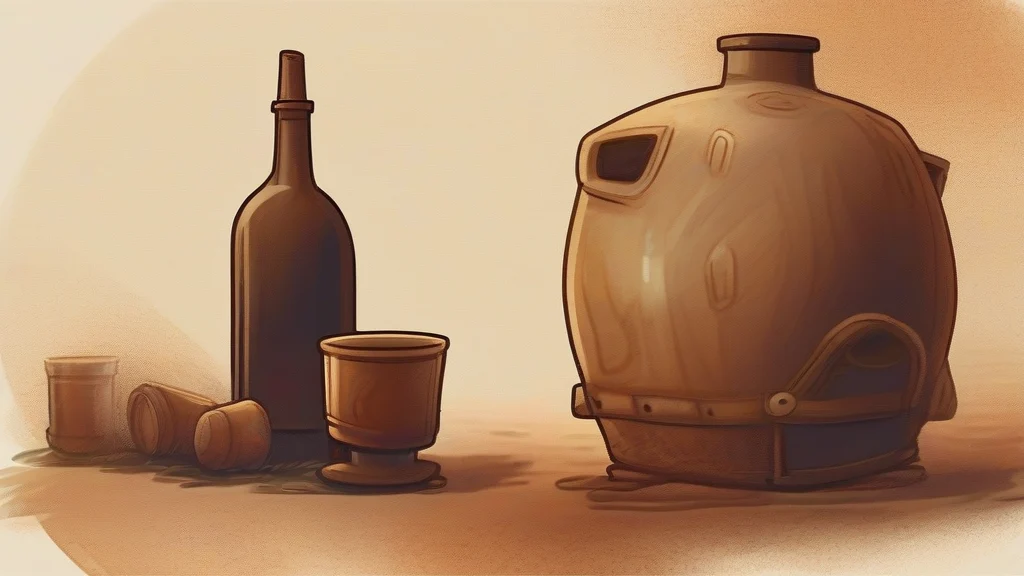
A flagon is a large bottle, traditionally fitted with a handle and a spout or narrow neck, used for holding and pouring wine, ale, or other beverages. The word carries strong historical associations: flagons of leather, pewter, earthenware, or silver were standard table equipment in medieval and early modern households, and they survive today chiefly in church use, where communion wine is often served from one, and in historical writing. In modern English, 'flagon' is largely a literary or archaic term, evoking taverns, banquets, and country inns more than contemporary kitchens. Beyond naming the vessel itself, the word can also denote the quantity of liquid such a bottle holds. For readers, it is useful both as vocabulary and as a window into how drinking vessels shaped the language of hospitality.
nounA large bottle, usually with a handle and spout, used for holding wine or other liquids; also the quantity of liquid such a vessel contains.
- A large bottle with a handle and spout for holding and pouring wine, ale, or other drink.
- The capacity or measure of liquid contained by such a bottle.
"The innkeeper filled a leather flagon with ale and set it before the weary travellers."
"She poured dark red wine from an earthenware flagon into each of the goblets."
"In Tudor kitchens, pewter flagons stood ready on the sideboard for serving ale at mealtimes."
Regular plural; simply add -s.
"The cellar was stocked with rows of dusty flagons."
The word 'flask' and 'flagon' share a common ancestor — and so does 'fiasco', which Italians once meant as the flask that shattered in the glassblower's hands.
Reviewed by Deb Chak, Editor. AI-assisted content curated by RJS Tech Solutions LLP.
Etymology of flagon
Flagon entered English in the Middle Ages, borrowed from Old French forms such as 'flacon' and 'flagon', which derived from Vulgar Latin '*flasconem', meaning a bottle. This Latin form traces back through Frankish '*flaska' to Germanic roots, making 'flagon' a cousin of 'flask' and even of the Italian 'fiasco'. The word has been part of English since roughly the thirteenth century, long established in household and ecclesiastical use.
How flagon is actually used
Flagon has an old-fashioned, literary flavour today: it appears most often in historical fiction, descriptions of taverns, and church contexts (communion wine), rather than everyday speech.
Easily confused with flagon
A flask is a small, flat-sided container typically pocket-sized or laboratory glassware, whereas a flagon is a large handled bottle for serving drink at the table.