
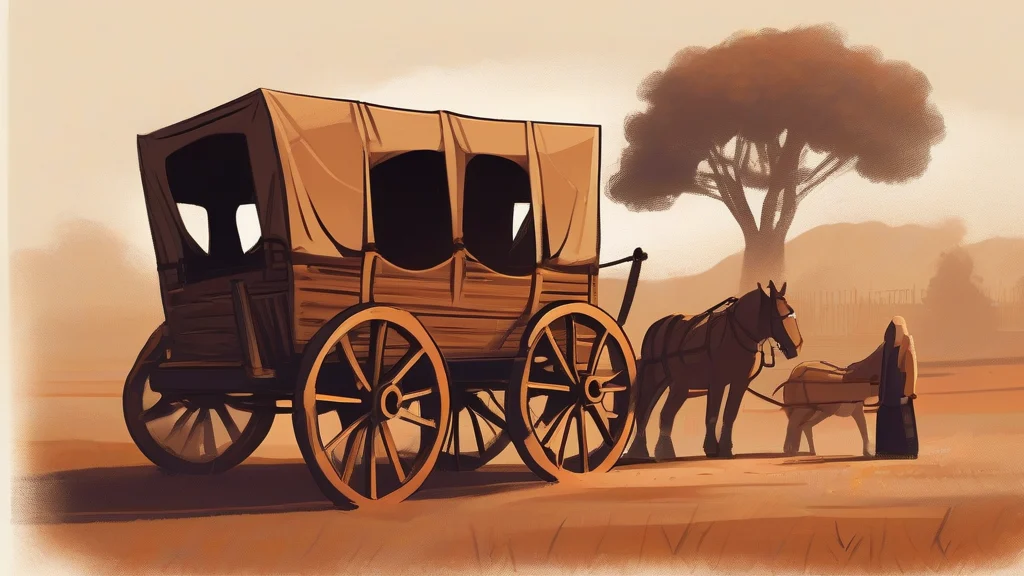
What does wagon mean?
A wagon is a four-wheeled vehicle traditionally drawn by horses or other draft animals and used to carry people, agricultural produce, or freight. Historically, wagons were central to farming, trade, military movement, and travel, which is why the word still evokes rural landscapes, covered-wagon journeys, and old forms of transport. In modern English, it can also mean a railway freight car, especially in industrial terminology. Informally, “the wagon” may refer to a group or political faction a person belongs to or supports. The expression “on the wagon” means abstaining from alcohol or other intoxicants. Wagon remains more familiar and often more nostalgic than the broader word vehicle, while the spelling waggon is particularly associated with British usage.
A four-wheeled vehicle, traditionally pulled by animals, for carrying people or goods. The word can also denote a railway freight car and, informally, a group or faction.
"A farmer drove the wagon along the narrow country road."
The vehicle sense is standard in British and American English. The group or faction sense is informal.
Chiefly North American and informal: to travel in a wagon.
"They wagoned across the prairie in a canvas-covered wagon."
This verb is relatively uncommon and is associated especially with informal or nostalgic contexts.
The regular plural adds -s; waggons is also possible when using the alternative British spelling.
"Several wagons were parked beside the barn."
Before motor vehicles became widespread, the wagon was one of the most important ways to move people, goods, and news—and the phrase “on the wagon” still echoes its everyday history.
Reviewed by Deb Chak, Editor. AI-assisted content curated by RJS Tech Solutions LLP.
Where does wagon come from?
The English word entered Middle English in forms such as wagon and wagoun, borrowing from Old Norse vagn. Old Norse vagn belongs to a Germanic family that includes Dutch wagen, German Wagen, Swedish vagn, and Danish vogn, as well as the archaic English wain. These words are ultimately associated with a Proto-Indo-European root meaning “to carry in a vehicle,” reflecting the wagon’s longstanding role as a means of transport.
Related word forms
How wagon is actually used
As a vehicle term, wagon is standard in both British and American English. The sense for a group or faction is informal and often carries the idea of joining or supporting a particular side. The verb is chiefly North American and less common than the noun.
Easily confused with wagon
Waggon is an alternative spelling of wagon, especially common in British English.