What does flamenco mean?
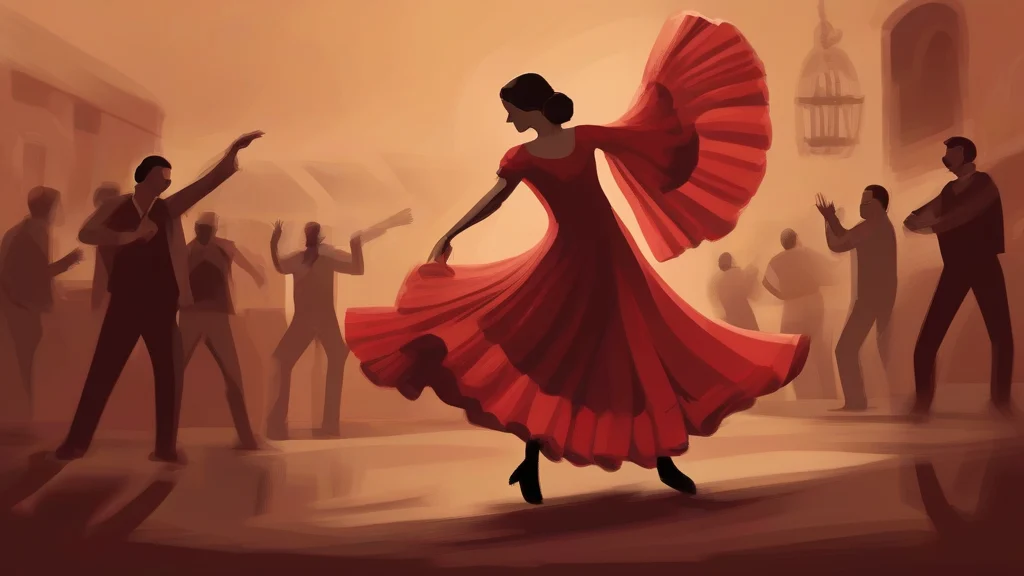
Flamenco is a powerful artistic tradition from southern Spain that unites singing, guitar playing, dancing, and rhythmic hand-clapping into a single deeply emotional performance. It originated among the Roma (Gitano) communities of Andalusia, absorbing influences from Moorish, Jewish, and Castilian musical traditions over centuries. In everyday English, calling something flamenco usually evokes vivid imagery: a dancer's stamped heels, swirling skirts, and a guitarist driving the rhythm forward. The word functions as a noun for both the genre and an individual dance, and it can describe related things such as a flamenco guitarist or flamenco dress. Flamenco carries strong connotations of passion, intensity, sorrow, and defiance — qualities summed up by the Spanish notion of duende, a heightened state of artistic authenticity. In 2010, UNESCO inscribed flamenco on its list of Intangible Cultural Heritage, confirming its status not merely as entertainment but as a defining expression of Spanish cultural identity admired worldwide.
A style of Spanish music and dance originating in Andalusia, marked by expressive song, virtuosic guitar, rhythmic clapping, and percussive footwork.
"The festival featured three nights of flamenco in the town square."
Often used as an uncountable noun for the art form as a whole; countable when denoting a single dance piece or number.
An individual dance performed in the flamenco style.
"She ended the recital with a breathtaking solo flamenco."
Countable usage; commonly paired with verbs like perform, dance, or learn.
The plural applies only when referring to individual dances or pieces in the flamenco style, not to the art form generally, which is treated as uncountable.
"The program included two lively flamencos followed by a somber soleá."
Despite its name literally meaning 'Fleming' — a person from Flanders — flamenco was born among the Roma communities of Andalusia and is now UNESCO-listed as intangible cultural heritage of humanity.
Reviewed by Deb Chak, Editor. AI-assisted content curated by RJS Tech Solutions LLP.
Etymology of flamenco
The word 'flamenco' comes from Spanish flamenco, which originally meant 'a Fleming', a person from Flanders, derived from Old French flamenc. The term entered Spanish in the medieval period via contacts between Spain and the Low Countries. How it came to denote the Andalusian song-and-dance tradition is debated, with theories linking it to Flemish courtiers, to the appearance of Gitano people, or to Arabic-influenced slang, but no single explanation is definitively established. A notable cognate is 'flamingo', the bird name, which likewise traces back through Iberian Romance languages to the same root sense of 'Flemish'.
How flamenco is actually used
In English, 'flamenco' most often refers to the art form as a whole, but within Spanish-speaking and flamenco circles it encompasses distinct components — cante (song), toque (guitar playing), baile (dance), and palmas (hand-clapping) — each regarded as its own discipline. The word is uncountable when referring to the genre generally but countable when referring to an individual dance performance.
Easily confused with flamenco
A flamenco is a Spanish song-and-dance tradition, while a flamingo is a pink wading bird — though both words derive from the same root meaning 'Fleming'.