What does flamingo mean?
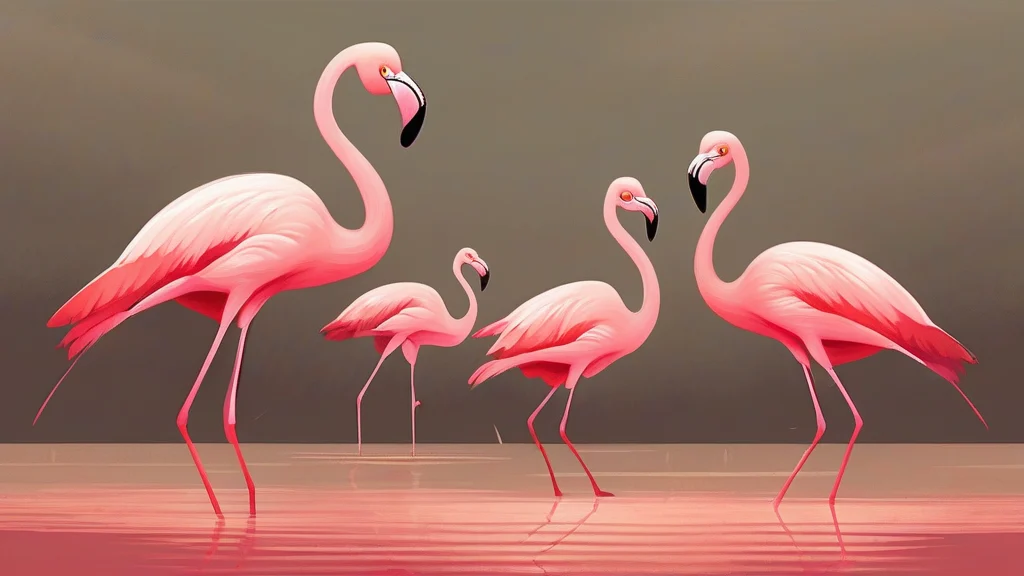
The flamingo is a large, unmistakable wading bird found across warm regions of the Americas, Africa, southern Europe, and Asia, recognized by its stilt-like legs, sinuous neck, and vivid pink or coral plumage. That famous colouring is not innate: flamingos hatch with grey feathers and acquire their pink hue from carotenoid pigments in the brine shrimp and algae they filter from shallow water with their peculiar upside-down bills. The word also lends itself to 'flamingo pink', describing a pale reddish-pink shade reminiscent of the bird's feathers. In everyday English, 'flamingo' appears both in natural-history contexts and in playful cultural ones, from tropical décor to the plastic lawn ornament that became an American icon. Its plural is normally 'flamingos', though 'flamingoes' survives as a chiefly British variant. The name itself, borrowed through Spanish and Portuguese in the early modern period, is thought to reflect the bird's flame-like colouring.
A large gregarious wading bird of the family Phoenicopteridae, with long stilt-like legs, a long curved neck, and pink or reddish-white plumage.
"The flamingos fed by sweeping their downturned bills through the shallows."
Plural is usually 'flamingos'; 'flamingoes' is a chiefly British variant.
A shade of light pinkish-red resembling the plumage of a flamingo, often called 'flamingo pink'.
"The bridesmaids wore flamingo-pink dresses."
Both 'flamingos' and 'flamingoes' are acceptable; 'flamingos' predominates in American usage and is now common everywhere, while 'flamingoes' persists mainly in British sources.
"Flamingos can gather in flocks numbering tens of thousands."
Flamingos are born grey — their famous pink colour comes entirely from the carotenoids in the shrimp and algae they eat.
Reviewed by Deb Chak, Editor. AI-assisted content curated by RJS Tech Solutions LLP.
Etymology of flamingo
The word 'flamingo' entered English in the late sixteenth or early seventeenth century, borrowed from Portuguese 'flamengo' or Spanish 'flamenco', which referred to the bird. These Iberian forms are generally linked to Old Provençal and are commonly explained as meaning 'flame-coloured', a nod to the bird's fiery plumage, making it a distant relative of words built on the Latin 'flamma' (flame). The same Spanish word 'flamenco' later gave its name to the Andalusian song and dance style, so the bird and the art form share a single linguistic ancestor.
How flamingo is actually used
The standard plural is 'flamingos' in American English, though 'flamingoes' is an accepted British variant. The bird carries strong decorative and kitsch associations in popular culture, especially the plastic garden ornament popularized in mid-20th-century America.
Easily confused with flamingo
Flamenco is a passionate Spanish music and dance style, whereas a flamingo is a pink wading bird — though the two words share the same Spanish source.