What does flange mean?
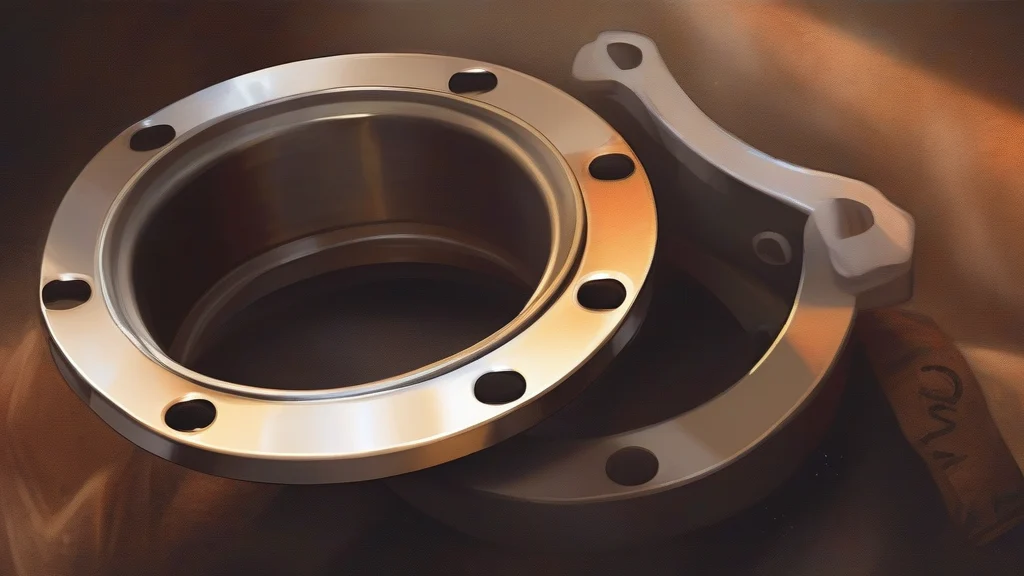
A flange is a projecting rim, collar, or lip built into an object — most often a pipe, wheel, beam, or machine component — whose purpose is practical: it lets parts be bolted or welded together, stiffens a structure, or guides movement along a fixed path. The word belongs firmly to the world of engineering and trades, where flanges are everywhere yet rarely noticed: the joined rings on industrial pipework, the plate under a toilet that secures it to the drain, and the subtle inner lip of a train wheel that keeps it locked against the rail are all flanges. Because the shape is defined by function rather than appearance, flange has no single fixed form, which makes it a genuinely useful concept rather than just a part name. Its connotations are entirely neutral and technical, though its odd sound and obscure origins have given it a second life as a byword for plausible-sounding jargon — and, in Britain, as the punchline of a famous pub-quiz joke about baboons.
A projecting flat rim, collar, or rib on an object, used for strength, attachment, or guidance — as on pipes, wheels, beams, or castings.
"Maintenance crews inspected every flange along the pipeline for signs of leakage."
Also used specifically for the raised inner edge of a railway wheel that bears against the rail.
To provide or fit an object with a flange; to bend or shape a rim outward.
"The sheet-metal worker flanged the edges of the panel before riveting it in place."
Usually encountered in passive or participial form ('flanged', 'flanging') in trade contexts.
Regular plural; common when referring to multiple fittings or wheel rims.
"The shipment arrived with spare gaskets and six steel flanges."
Ask a British pub quiz what you call a group of baboons and someone will inevitably shout "a flange" — a joke answer from a comedy sketch that stuck so hard it now appears in serious dictionaries of collective nouns.
Reviewed by Deb Chak, Editor. AI-assisted content curated by RJS Tech Solutions LLP.
Etymology of flange
The origin of flange is genuinely uncertain, which lexicographers have long acknowledged. It appeared in English in the early seventeenth century, apparently as a variant or alteration of flanch (also spelled flanker or flanche in older sources), itself borrowed from Old French, where flanc meant the flank or side of a body or object and yielded the heraldic term flanch. From this vague beginning the word settled into engineering vocabulary during the Industrial Revolution, when bolted pipe and wheel rims made it indispensable. Its French-rooted cousin flanch survives mainly in heraldry, making the two words rare examples of siblings that drifted into very different worlds.
Related word forms
How flange is actually used
Flange is overwhelmingly a technical word, encountered in engineering, plumbing, and railway contexts rather than everyday conversation; it carries a neutral, practical connotation and is occasionally used humorously as shorthand for vaguely mechanical-sounding jargon.
Easily confused with flange
A phalange is a bone of the finger or toe (and the source of a common misspelling of flange as 'phlange'), whereas a flange is a mechanical rim or collar.