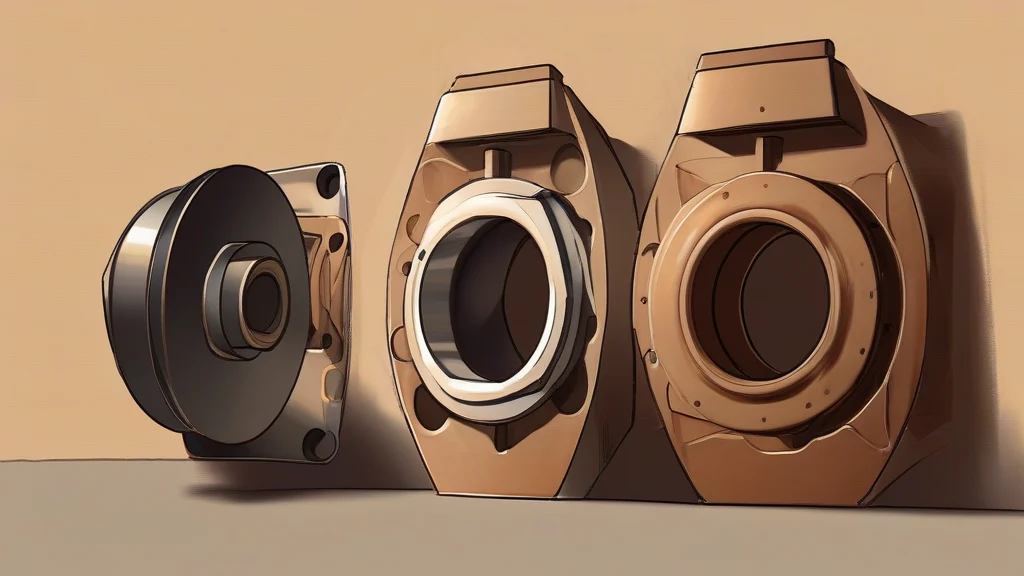
What does flanged mean?
"Flanged" is an adjective describing something fitted with a flange — a projecting rim, lip, collar, or rib along its edge. Though the word sounds specialized, flanged components are everywhere in daily life: train and tram wheels carry a flanged inner lip that guides them along the rails, and pipes, valves, and couplings are commonly flanged so they can be bolted firmly together. The projection serves practical purposes: it adds rigidity, keeps parts aligned, prevents slippage, or provides a surface for fastening. Consequently, "flanged" belongs mainly to the vocabulary of engineering, plumbing, and manufacturing, appearing in technical specifications and product descriptions more often than in casual speech. It functions almost entirely attributively — one speaks of a flanged joint or flanged wheels — and its meaning is best grasped visually: picture a straight edge suddenly widening into a lip, and you have pictured something flanged. The word traces back through the noun "flange", whose own origins are uncertain but plausibly connected to older words for "flank" or "side".
Fitted with or characterized by a flange — a projecting rim, edge, collar, or rib used for strength, guidance, or connection.
"The engineer specified flanged bushings to stop the shaft from drifting sideways under load."
Almost always used attributively, immediately before the noun it modifies.
Past participle of the verb "to flange", meaning provided or equipped with a flange.
"Once the plates had been flanged at the edges, they could be riveted into a rigid panel."
Every railway wheel in the world carries a small flanged lip — a modest ridge of metal that has kept trains on their tracks since the earliest railways.
Reviewed by Deb Chak, Editor. AI-assisted content curated by RJS Tech Solutions LLP.
Etymology of flanged
"Flanged" derives from the noun "flange", a projecting rim or edge, which entered English usage in the technical vocabulary of metalwork and engineering. The ultimate origin of "flange" is uncertain, though it is often traced to a French word for "flank" or "side" (as in modern French "flanc"), suggesting the sense of the side or edge of an object. As industrial machinery and pipework developed from the eighteenth century onward, "flanged" became the standard adjectival form describing components fitted with such rims. Its sibling word "flank" shares this proposed root, both pointing to the notion of an object's lateral edge.
Related word forms
How flanged is actually used
"Flanged" is almost exclusively a technical term, encountered in engineering, plumbing, manufacturing, and construction documentation rather than everyday conversation. It is nearly always attributive, appearing directly before the noun it describes (a flanged valve, flanged wheels). The tone is neutral and descriptive, carrying no emotional connotation.
Easily confused with flanged
"Flange" is the noun naming the projecting rim itself, while "flanged" is the adjective describing an object that has such a rim.