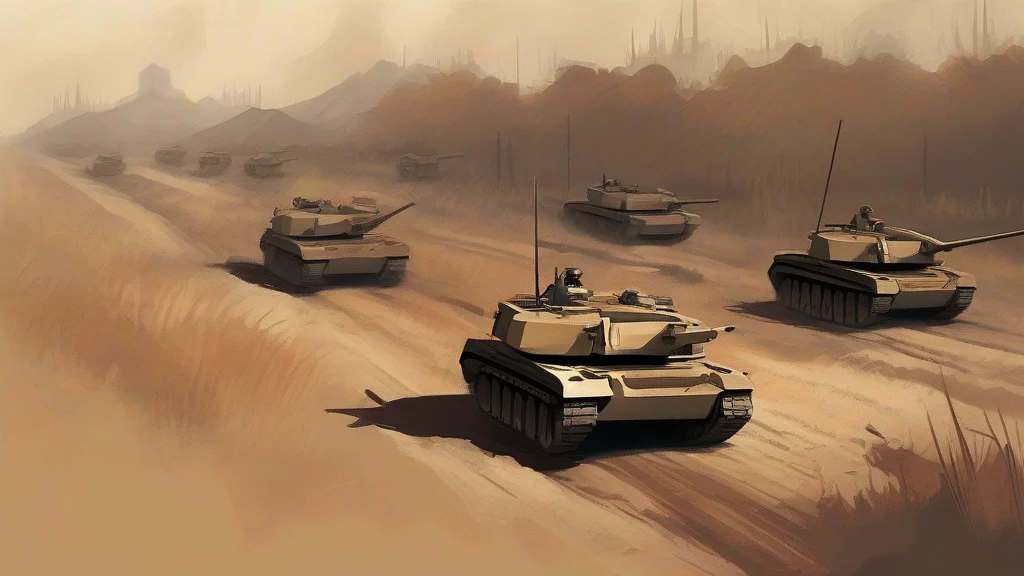
What does flanked mean?
'Flanked' is the past tense and past participle of the verb 'flank', meaning to be situated at the side or sides of something, usually closely and often symmetrically. A building may be flanked by towers, a speaker flanked by colleagues, a valley flanked by steep hills. The word lends description a sense of framing and formality, which is why it appears so frequently in journalism, portraiture, and ceremonial accounts: to say someone is 'flanked by' others is to present them as the centre of a deliberate arrangement. In military language, 'flanked' carries a second, tactical sense — to have moved against the side of an enemy formation, where defences are traditionally weakest, rather than attacking head-on. The term derives from 'flank', itself from Old French 'flanc', meaning the side of a human or animal body, so the word's history runs from anatomy through architecture to battlefield manoeuvre. Its enduring usefulness lies in how precisely it conveys position: not surrounded, not merely nearby, but specifically beside.
verb (past tense and past participle)To have been positioned at the side or sides of something or someone, typically in close proximity; in military contexts, to have attacked or guarded an enemy's side or flank.
- Positioned at or beside the flank or side of something or someone, often symmetrically ('flanked by trees')
- In military usage: having attacked, threatened, or turned the side of an enemy formation, or having guarded one's own side
"The president walked to the podium, flanked by two senior advisors."
"The bride stood at the altar flanked by her sisters and closest friends."
"The general sent a cavalry unit to flank the enemy's exposed left wing before the assault began."
When you're 'flanked,' your body has become a piece of architecture — English literally borrowed a word for the side of a building or body to describe being framed like a monument between two things.
Reviewed by Deb Chak, Editor. AI-assisted content curated by RJS Tech Solutions LLP.
Etymology of flanked
'Flanked' comes from the verb 'flank', which English borrowed in the late medieval or early modern period from Old French 'flanc', meaning the side of the body between the ribs and the hip. The French word itself traces back to a Germanic source (Frankish *flankô, 'the side'), making it a Germanic loan that passed through Romance languages before returning to English. The military sense of attacking an enemy's side developed alongside the anatomical one, and derived forms such as 'flanker' and 'flanking fire' became established in military vocabulary.
Related word forms
How flanked is actually used
'Flanked' most often appears in passive constructions introduced by 'by' or 'on either side', giving a formal, slightly ceremonial tone — common in journalism describing processions, portraits, landscapes, and official events. In military writing it carries a tactical meaning of attacking or securing a side.