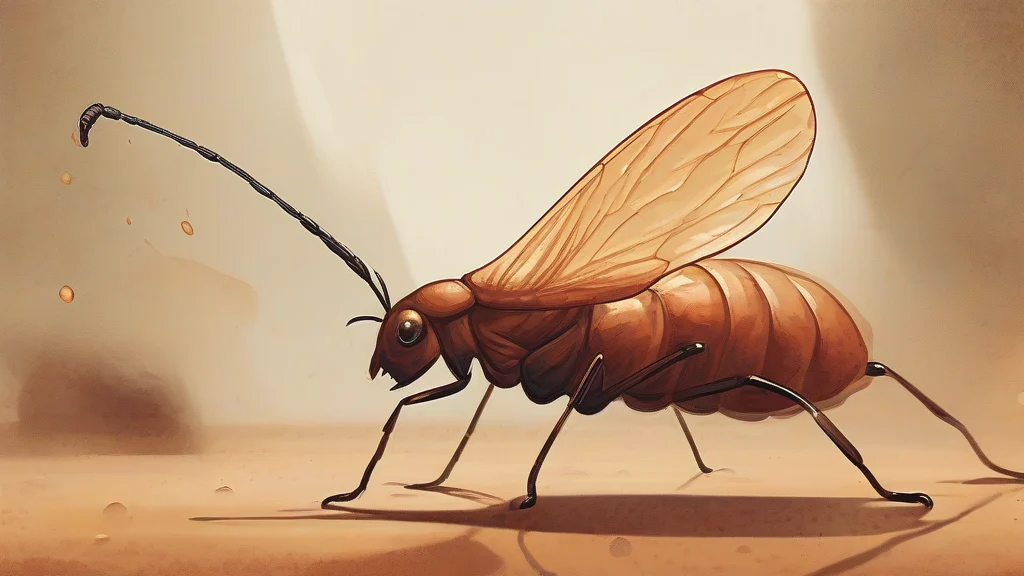
What does flea mean?
A flea is a minute, wingless insect that survives by sucking the blood of mammals and birds, propelling itself between hosts with extraordinary leaps powered by its hind legs. Though barely visible, fleas have shaped human history: the rat flea transmitted the bubonic plague that devastated medieval Europe. In everyday English, the word carries strongly itchy, unhygienic connotations — pet owners battle 'flea infestations', and 'flea-bitten' describes anything shabby or worn. Yet the word also appears in cheerier contexts: a 'flea market' is a lively bazaar of second-hand bargains, and a 'flea circus' was once a popular curiosity. For learners, 'flea' is worth knowing both as a concrete biological term and as a vivid source of idiomatic colour. It is frequently confused in spelling with the verb 'flee', which means to run away — an irony, given that a flea's defining talent is exactly that.
nounA tiny wingless bloodsucking insect that leaps onto mammals and birds and feeds on their blood, often transmitting disease.
- A small wingless jumping insect that feeds on the blood of mammals and birds.
- (informal, chiefly attributive) Something cheap, shabby, or second-hand, as in 'flea market'.
"The dog scratched furiously after picking up fleas from the kennel."
"We had to fumigate the whole house after the cat brought in fleas."
"She found a vintage brass lamp at a flea market for ten dollars."
Regular plural; 'fleas' is more common than the singular in everyday use, since infestations involve many insects.
"The vet treated all three kittens for fleas."
Fleas can leap well over a hundred times their own body length — and one species of rat flea helped spread the Black Death across medieval Europe.
Reviewed by Deb Chak, Editor. AI-assisted content curated by RJS Tech Solutions LLP.
Etymology of flea
The word 'flea' descends directly from Old English 'flēah', making it one of the oldest attested words in the language, and it shares its Germanic root with related West Germanic forms such as Dutch 'vlo' and German 'Floh'. The name has remained remarkably stable across more than a thousand years, reflecting how familiar these pests were to early speakers. Its Germanic origin distinguishes it from the many English words borrowed from Latin and French.
How flea is actually used
Almost always used negatively or humorously, evoking itchiness, infestation, and poverty; 'flea-bitten' describes both animals and shabby appearance. The plural 'fleas' is standard; there are no common adjective or verb derivatives of the word itself.
Easily confused with flea
'Flea' is a noun for the jumping insect, while 'flee' is a verb meaning to run away.