
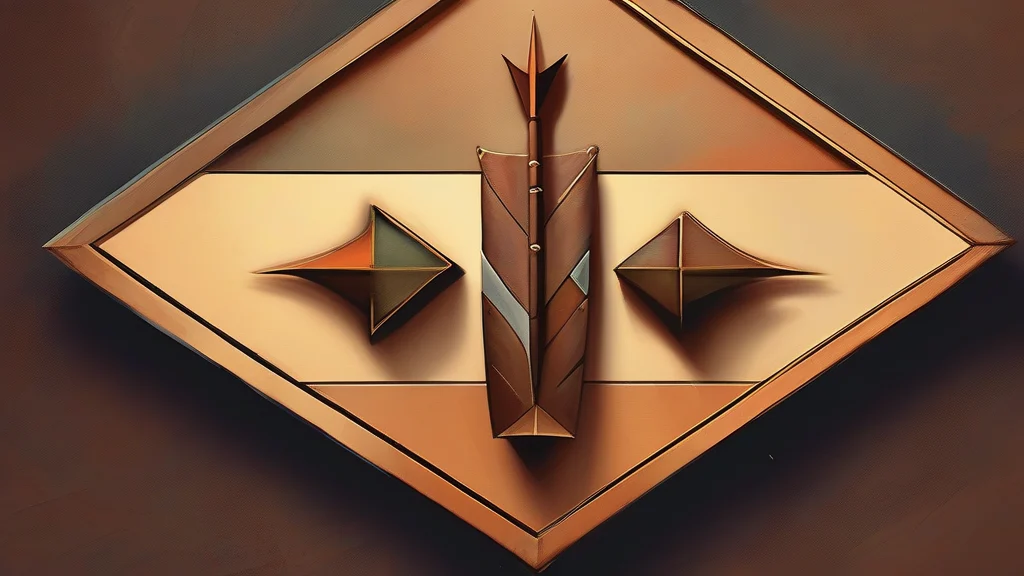
What does fleche mean?
A fleche is most often a heraldic charge shaped like an arrow. Unlike a literal arrow, however, a heraldic fleche is usually drawn without a head, emphasizing its characteristic narrow shaft and pointed outline. Fleches can be placed singly or in groups and may be combined with other charges to create distinctive arms. The word can also denote a slender architectural spire, especially one rising above a pitched roof. In general use, “fleche” is rare and technical rather than everyday, so it is most likely to be encountered in descriptions of coats of arms, heraldry, or historic buildings. The alternative spelling “flèche” preserves the accent of the French source and is particularly common in architectural writing. Although a fleche looks at first like a simple arrow, its heraldic function and usually headless form distinguish it from an ordinary arrow, while its relationship to the English word fletch connects it to a familiar piece of archery equipment.
nounIn heraldry, a stylized arrow, typically without a head, used as a charge. More rarely, it refers to a slender architectural spire.
- A stylized arrow, usually without a head, employed as a heraldic charge.
- A slender spire, especially one rising from a roof or other architectural structure.
"The shield bore three silver fleches arranged in a row."
"The heralds carefully aligned the three fleches across the lower field of the shield."
"A narrow fleche crowns the building's steeply pitched roof."
The unaccented plural is fleches; flèches is also used when retaining the French-style accent.
"Two fleches appeared above the motto on the ancient seal."
A fleche resembles an arrow, but heraldic convention usually leaves off the point.
Reviewed by Deb Chak, Editor. AI-assisted content curated by RJS Tech Solutions LLP.
Where does fleche come from?
The word was borrowed into English from Old French fleche, meaning “arrow,” which was in turn derived from Latin flēcca, also meaning “arrow.” Its long-established English use is chiefly associated with heraldry, where the term denotes an arrow-shaped charge. The related English word fletch refers to an arrow's feather, while fletcher originally meant an arrow maker; all trace back to the same French and Latin source.
How fleche is actually used
This is an uncommon specialist term. It is most familiar in heraldry, where the charge is generally depicted as an arrow without a head; the spelling flèche is also common, especially in architectural and international heraldic usage.
Easily confused with fleche
A fletch is one of the feathers attached to an arrow, whereas a fleche is an entire arrow-shaped heraldic charge.