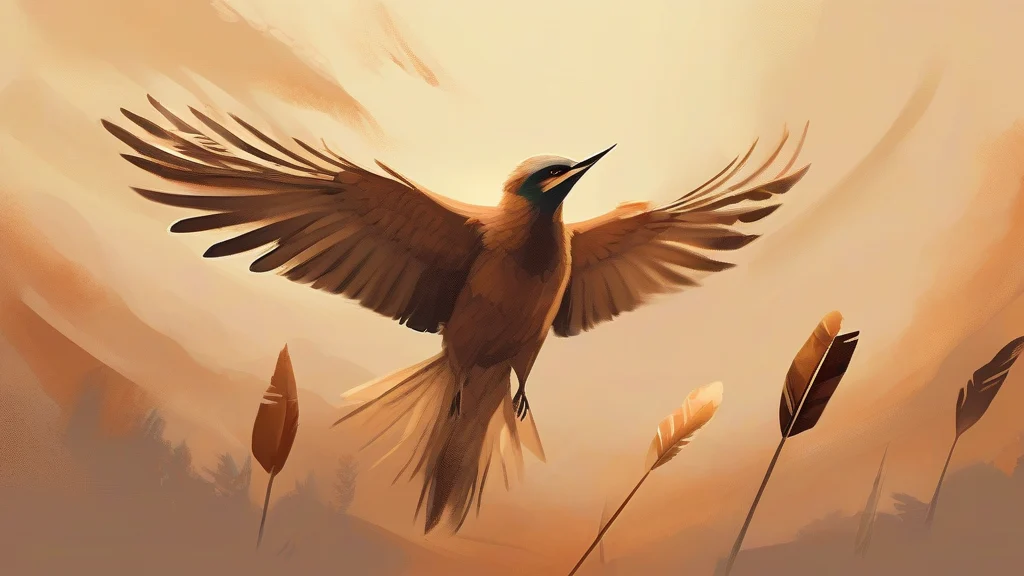
What does fletch mean?
To fletch is to equip an arrow with feathers or vanes near its rear end so that it flies straight and true. The fletching creates drag and spin that stabilize the shaft in flight, making it one of the most crucial steps in traditional arrow-making. The verb belongs chiefly to the specialized vocabularies of archery, bow-hunting, and historical craftsmanship, though it has gained wider recognition through the popularity of traditional archery and fantasy fiction. Its derivatives are equally specific: a 'fletcher' is a person who makes arrows, and 'fletching' denotes the feathers or vanes themselves. The word descends from Old French 'flèche', meaning arrow, which ultimately traces back to a Germanic source. Anyone interested in how archers dominated medieval warfare will find in 'fletch' a compact reminder that behind every famous volley stood skilled artisans carefully binding feather to shaft.
verbTo fletch an arrow is to fit it with feathers or vanes at its rear end, stabilizing it in flight. By extension, the term can refer to providing such flight-stabilizing feathers themselves.
- To fit an arrow with feathers or vanes at the nock end to stabilize its flight.
"The craftsman would fletch each arrow by hand, binding three goose-feather vanes along the shaft."
"She learned to fletch arrows with turkey feathers using sinew and hide glue."
"Medieval fletchers could fletch dozens of arrows in a single day for the king's archers."
Every arrow that ever flew straight owed its accuracy to someone who knew how to fletch — and the man who did it for a living gave us the surname Fletcher.
Reviewed by Deb Chak, Editor. AI-assisted content curated by RJS Tech Solutions LLP.
Etymology of fletch
'Fletch' comes from the Old French 'flèche', meaning 'arrow', which was itself adopted from a Germanic language — most likely Frankish — during the early medieval period. The verb entered Middle English in the context of archery, at a time when English armies depended heavily on longbowmen and their suppliers. The same root gives us 'fletcher', an occupational surname still common today, and the architectural term 'fleche', a slender spire over a church crossing.
Related word forms
How fletch is actually used
'Fletch' is a technical term belonging mainly to archery, bow-making, and historical craft contexts; it is rare in everyday conversation. The noun 'fletching' refers to the feathers themselves, and 'fletcher' denotes a maker of arrows.
Easily confused with fletch
'Fetch' means to go and retrieve something, while 'fletch' means to attach feathers to an arrow — the two verbs look and sound nearly alike but share no connection in meaning.