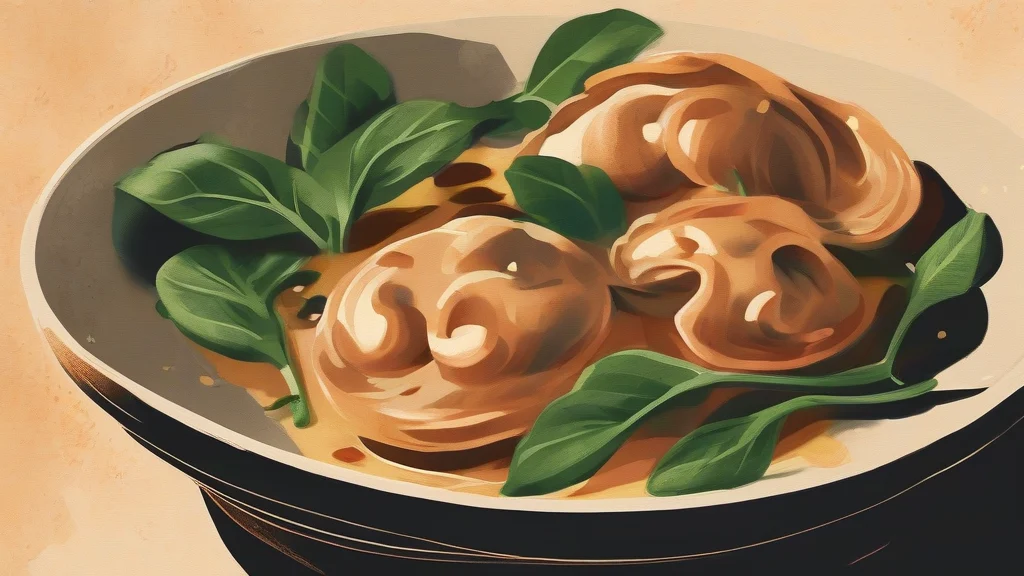
What does florentine mean?
Florentine means 'of Florence': it describes anything connected to that celebrated Italian city, whether a painter, a manuscript such as the Florentine Codex, or the architectural elegance of the Renaissance. In cooking, the word has taken on a second life — a dish served 'Florentine' is built around spinach, most famously in eggs Florentine, a brunch classic pairing poached eggs and spinach beneath hollandaise or cheese sauce on a muffin half. Tradition attributes this style to Catherine de' Medici, whose marriage into the French court reputedly carried Florentine tastes northward. As an ordinary noun, a florentine is also a crisp confection of almonds or other nuts and candied fruit bound in caramel, often finished with a layer of chocolate. The word carries connotations of refinement and old-world craft, and its flexibility across art history, gastronomy, and pâtisserie makes it a quietly versatile term worth knowing.
Of or relating to Florence, Italy, its inhabitants, or their characteristic artistic and cultural style.
"The gallery acquired a rare Florentine painting from the early Renaissance."
Capitalized when used as a proper adjective.
(Cooking) Served on or garnished with spinach, typically with a cheese or cream sauce.
"For dinner he chose sole Florentine with a side of roasted potatoes."
Capitalized on menus; used almost exclusively in food contexts.
A flat, crisp biscuit made of nuts and candied fruit cooked in caramel, often coated on one side with chocolate.
"She bought a box of Florentines to take to her grandmother."
Often written lowercase ('florentine') in British usage; plural 'florentines'.
A native or inhabitant of Florence.
"As a true Florentine, she took Dante and the Duomo personally."
Capitalized; relatively uncommon compared with the adjectival senses.
Only the noun senses take a plural. Lowercase 'florentines' refers to the biscuits; capitalized 'Florentines' refers to the people of Florence. The adjective has no plural form.
"The patisserie sells chocolate-dipped florentines by the bag."
Order something 'Florentine' at a restaurant and you'll get spinach on it — a culinary tradition credited to Catherine de' Medici, who carried her Florentine tastes to the French court when she married a future king of France.
Reviewed by Deb Chak, Editor. AI-assisted content curated by RJS Tech Solutions LLP.
Etymology of florentine
Florentine derives from Latin Florentinus, meaning 'of Florence', itself based on Florentia, the Roman name of the city founded by Julius Caesar — a name rooted in Latin florens, 'flourishing, blooming', from flos ('flower'). The same Latin root gives English 'flower', 'flour', 'flora', and 'flourish'. The word entered English via French and Italian during the medieval and Renaissance periods, when Florence's banking, art, and political power made the adjective genuinely useful across Europe.
How florentine is actually used
When referring to Florence, its people, or spinach-topped cuisine, 'Florentine' is normally capitalized as a proper adjective. Only the small nut-and-chocolate biscuit takes the lowercase form 'florentine'. The culinary sense is chiefly used in menus and food writing; the pastry sense is chiefly British.
Easily confused with florentine
'Florentine' relates to Florence, Italy, while 'Floridian' relates to the state of Florida in the United States.