What does floury mean?
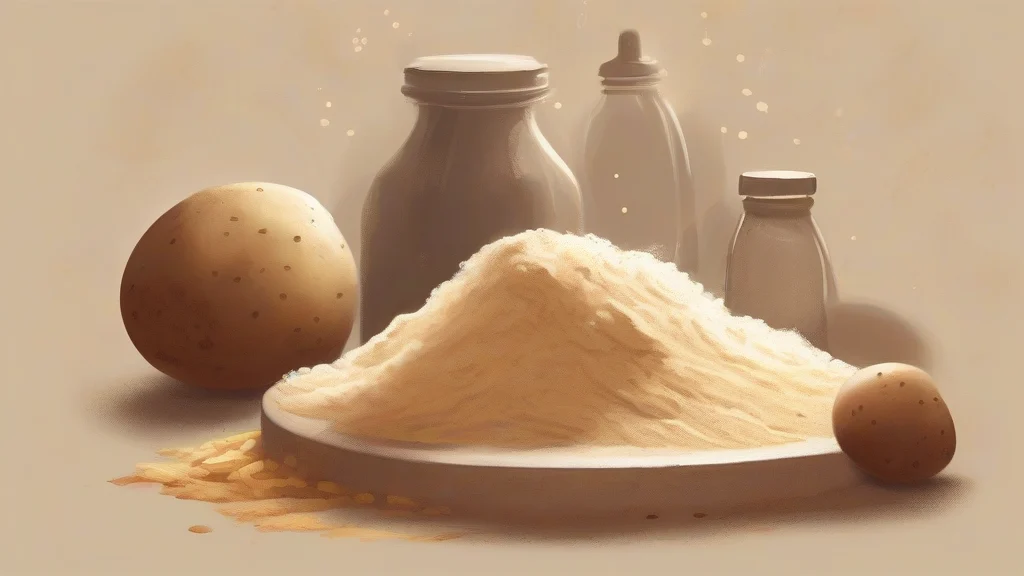
Floury is an adjective describing something covered with flour, resembling flour, or possessing flour's characteristic dry, powdery softness. Its most visible use is literal — floury hands, a floury worktop, a floury loaf fresh from the oven — evoking the atmosphere of a working kitchen. Its second major sense belongs to the world of food, especially in Britain: a floury potato is one with high starch content that turns light and fluffy when boiled or roasted, prized for mash and roasties in contrast to firm, waxy varieties; floury apples similarly break down into a soft, mealy texture when cooked. The word derives from 'flour', which itself comes from the French 'fleur', meaning 'flower' — originally denoting the finest, choicest part of the milled grain, just as a flower is the finest part of a plant. Homely and appetizing in connotation, floury is a small word with a surprisingly rich story.
Covered with or resembling flour; powdery or mealy in texture.
"He lifted the floury dough onto the peels and slid it into the oven."
When applied to potatoes or apples, the term signals a high-starch, soft-fleshed variety suited to mashing, roasting, or cooking down.
(Of starchy foods) having a light, mealy flesh that softens or breaks apart during cooking.
"A floury potato will give you the fluffiest mash you have ever tasted."
In Britain, 'floury' isn't an insult for a potato — it's exactly what you want for the perfect mash.
Reviewed by Deb Chak, Editor. AI-assisted content curated by RJS Tech Solutions LLP.
Etymology of floury
Floury is formed simply from the noun 'flour' plus the adjectival suffix '-y'. The noun itself entered Middle English as a variant spelling and sense of 'flower', borrowed from Old French 'flur' or 'fleur', and by the sixteenth century had come to mean specifically the finely ground, finest-quality meal of grain — metaphorically 'the flower' of the wheat. Cognates sharing this root include 'floral', 'florid', and 'flourish', all ultimately traceable to Latin 'flos', 'floris', meaning flower.
How floury is actually used
The word is everyday rather than technical, but its second sense is notably more prominent in British English, where cooks routinely classify potato varieties as 'floury' or 'waxy'. In describing hands, surfaces, or aprons, it carries a warm, homely connotation associated with baking and kitchens.
Easily confused with floury
'Flour' (and thus 'floury') refers to ground grain or powder, while 'flower' is the blossom of a plant — two distinct words that happen to share a spelling history and sound.