
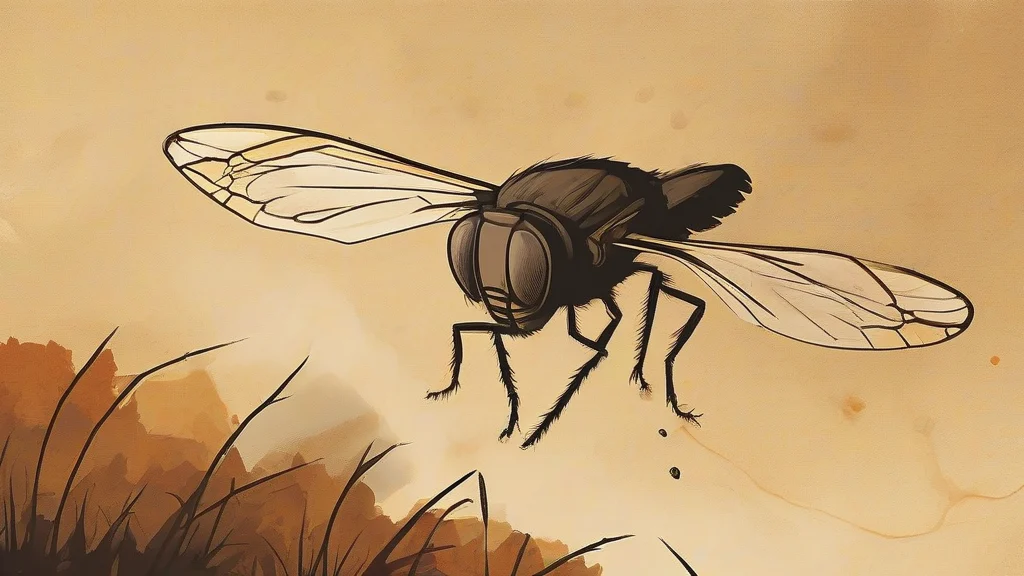
What does flypaper mean?
Flypaper is paper coated with a slow-drying sticky substance, traditionally sweetened and sometimes laced with insecticide, and hung from ceilings or rafters to catch flies and other flying insects that alight on it. Once a ubiquitous fixture of kitchens, stables, and shops before refrigeration and modern pest control, it is now largely associated with older or rural settings, giving the word a faintly nostalgic, old-fashioned flavor. Beyond its literal meaning, flypaper is sometimes used figuratively to describe anything that attracts and holds people or money inescapably — a tourist town described as 'flypaper for wallets', for instance. The word is transparently formed from 'fly' plus 'paper' and requires little explanation, yet it remains useful both as a concrete household term and as a vivid metaphor for seductive entrapment. Its plural form is simply 'flypapers'.
nounFlypaper is a strip or sheet of paper coated with a sticky, often sweet-smelling adhesive, hung indoors to trap flies and other flying insects that land on it.
- A strip of paper coated with sticky adhesive, hung to catch flies and other flying insects.
- (Figurative, less common) Something that attractively ensnares people, drawing them in as if stuck.
"The old farmhouse kitchen smelled of honey and hung with ribbons of flypaper."
"She hung a coil of flypaper above the stable door where the horseflies gathered."
"The casino proved to be flypaper for tourists' wallets: once inside, few left quickly."
The plural 'flypapers' is regular but uncommon, since the product is usually discussed as single strips; plural typically appears when referring to multiple strips or a supply of them.
"He bought a pack of six flypapers before the summer barbecue season."
Before electric zappers, kitchens fought flies with poison-sweet paper strips dangling from the ceiling — and Victorian-era arsenic-laced versions were so deadly they occasionally killed more than insects.
Reviewed by Deb Chak, Editor. AI-assisted content curated by RJS Tech Solutions LLP.
Where does flypaper come from?
Flypaper is a straightforward English compound of 'fly' — the insect noun, from Old English 'flēoge' — and 'paper', itself derived via Anglo-Norman and Latin from Greek 'papyros'. The compound emerged in the nineteenth century, when commercial sticky traps became widely manufactured and sold for household pest control. As a native English formation rather than a borrowing, it has no true cognates in other languages, though equivalent compounds exist elsewhere.
How flypaper is actually used
Flypaper is a concrete, everyday noun with no formal register constraints, though it now carries a slightly old-fashioned, rural, or vintage connotation, since modern pest control favors sprays, traps, and electric devices. It is almost always singular in use (one strip at a time) but takes a normal plural when several are meant. Figurative uses describing anything irresistibly sticky or ensnaring appear mainly in journalism and literary prose.
Easily confused with flypaper
A flyleaf is the blank leaf at the front or back of a book, whereas flypaper is an adhesive trap for catching flies.