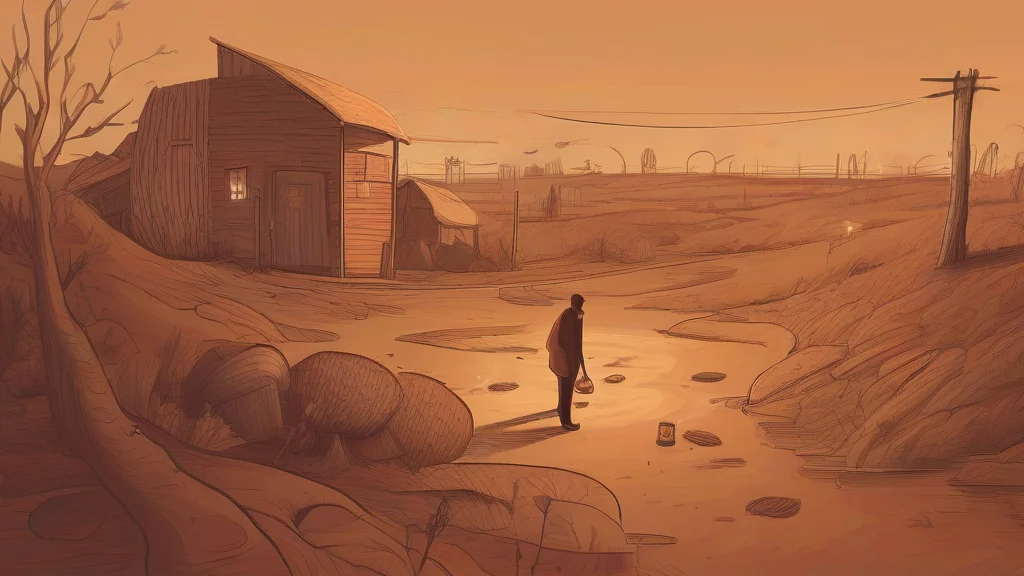
What does foodless mean?
'Foodless' is an adjective meaning lacking food — describing a person, household, place, or stretch of time in which no food is available or consumed. Formed on the pattern of English's prolific '-less' suffixes, it attaches the sense of absence to its base word: just as 'hopeless' means without hope, 'foodless' means without food. The word is uncommon in ordinary conversation, appearing more often in literary, historical, or journalistic writing that depicts famine, siege, poverty, shipwreck, or enforced fasting — a 'foodless night', a 'foodless winter', a 'foodless journey'. Its connotation is almost always grim: it evokes deprivation and hardship rather than voluntary dieting. Speakers today more often reach for 'starving', 'famished', or phrases like 'with nothing to eat', which gives 'foodless' a slightly formal or archaic flavor. Even so, it remains a precise, economical way to name hunger's circumstances — useful whenever a writer wants to state an absence plainly and let the reader feel its weight.
adjectiveLacking food; devoid of nourishment or provisions. It describes a place, time, situation, or person that offers or receives no food.
- (of a person, place, or period) lacking food or provisions; without food
"The stranded hikers spent a foodless night on the mountain before rescue arrived."
"The besieged city endured weeks of foodless despair before aid convoys broke through."
"After missing both lunch and dinner, he faced a long, foodless evening with nothing but water in the cupboard."
A word so spare it does only one thing — it names the absence of food — yet writers have reached for it for centuries to make hunger felt in a single syllable pair.
Reviewed by Deb Chak, Editor. AI-assisted content curated by RJS Tech Solutions LLP.
Etymology of foodless
'Foodless' is formed from 'food', the everyday English noun for sustenance, combined with the suffix '-less', from Old English '-lēas', meaning 'devoid of, without'. The base word 'food' itself derives from Middle English 'fode', a generalization related to 'feed' (Old English 'fōda' and 'fēdan'), tracing back to Proto-Germanic roots concerning nourishment and pasture. The '-less' suffix has been a productive source of adjectives of privation since the medieval period, giving English such formations as 'hopeless', 'restless', and countless others. 'Foodless' arose through this same native pattern of compounding rather than being borrowed from another language.
How foodless is actually used
'Foodless' is a relatively rare, somewhat literary adjective; everyday speech usually expresses the idea with phrases like 'with nothing to eat' or by calling someone 'starving' or 'famished'. It carries a negative, often sympathetic connotation of deprivation rather than casual dieting.
Easily confused with foodless
Though both end in '-ile/-less-like sounds and can seem similar in rapid reading, 'futile' means pointless or ineffective, whereas 'foodless' specifically means lacking food.
'Feckless' means irresponsible or lacking initiative, while 'foodless' means simply lacking food.