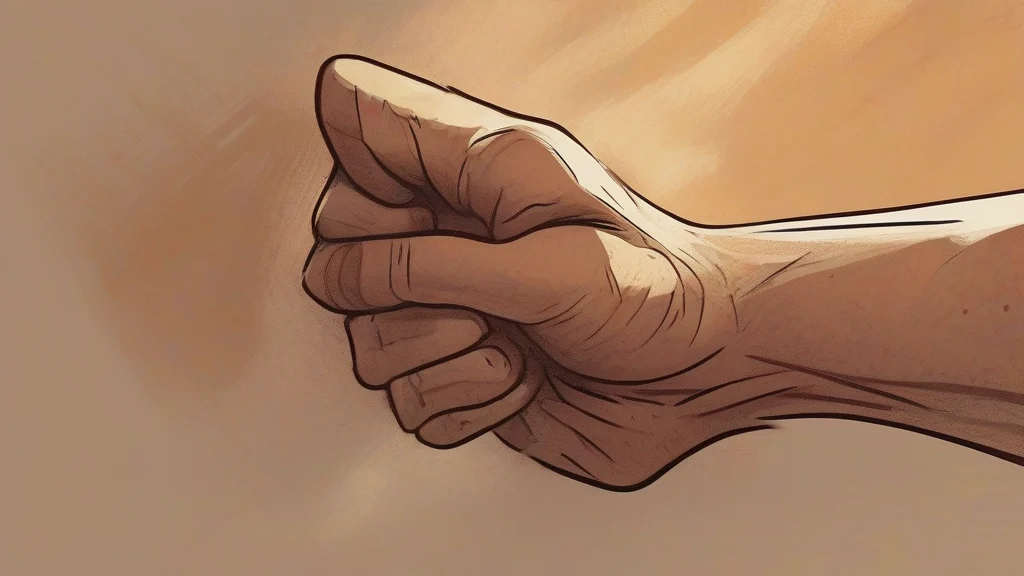
What does forearm mean?
The forearm is the section of the upper limb between the elbow and the wrist, housing two bones — the radius and the ulna — along with muscles that control movement of the hand and fingers. In anatomy and medicine it is a precise structural term, while in everyday speech it simply names that visible stretch of arm from elbow to wrist, often mentioned when describing sleeves, tattoos, injuries, or gestures. Forearm also functions as a rarer verb meaning to prepare in advance, especially for conflict or hardship, by arming or otherwise readying oneself; this usage lives on chiefly through the proverb 'forewarned is forearmed,' which urges that advance knowledge itself is a form of protection. The noun is neutral and universal, while the verb carries a slightly old-fashioned, strategic flavor. Together the two senses make forearm an unusually rich word: concrete in the anatomist's vocabulary, metaphorical in the strategist's, and memorable in both.
The part of the arm between the elbow and the wrist.
"The tennis player wore a sweatband on each forearm."
Standard in both everyday and medical contexts.
To prepare or equip oneself or others in advance for a difficulty, danger, or conflict.
"Knowing the negotiations would be tough, she forearmed herself with every fact she could gather."
Less common today; best known through the proverb 'forewarned is forearmed.'
The plural refers to the paired forearms of a person or to those of multiple individuals; the verb form does not have a plural.
"Both weightlifters had forearms like knotted rope."
'Forewarned is forearmed' pairs two ancient words into one of English's most enduring proverbs about being prepared.
Reviewed by Deb Chak, Editor. AI-assisted content curated by RJS Tech Solutions LLP.
Etymology of forearm
Both senses derive from the Old English prefix 'fore-,' meaning 'before' or 'in front,' combined with 'arm.' The anatomical sense simply names the part of the arm positioned before — nearer than — the upper arm, and has been used in English since at least the early modern period. The verb 'forearm,' meaning to arm beforehand, arose from the same logic of preparation, appearing by around the 16th century. Its many sibling terms — forecast, foresee, foretell, foreshadow — all share this productive Germanic prefix, which survives robustly in modern English.
Related word forms
How forearm is actually used
The noun is standard and neutral across registers, common in anatomy, medicine, and everyday description. The verb is less common today but survives strongly in idiomatic use, most famously in the proverb 'forewarned is forearmed.' The stress pattern differs: the noun stresses the first syllable, while the verb stresses the second, mirroring other two-syllable verb pairs like 'record.'
Easily confused with forearm
To forearm is to equip or prepare physically or mentally in advance, while to forewarn is to warn someone of something before it happens.