What does foreleg mean?
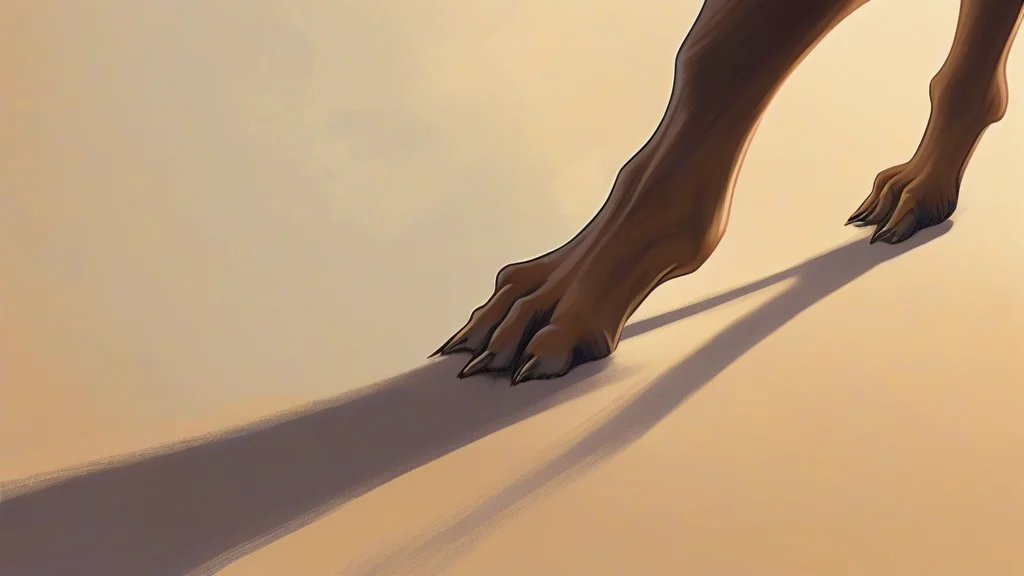
A foreleg is one of the two front legs of a four-legged animal — the limbs of a horse, dog, cat, lion, or elephant that correspond roughly to our arms. The word belongs chiefly to the vocabulary of veterinary medicine, zoology, horsemanship, and nature writing, where precision matters: saying a greyhound fractured a foreleg or that a bear rose onto its forelegs conveys exactly which limbs are meant. It carries no emotional charge; it is simply a neutral, descriptive anatomical term, in contrast with its counterpart, the hind leg or hindlimb. The word is formed from the prefix 'fore-', meaning 'before' or 'in front', joined to 'leg', and it sits alongside siblings like forearm and foremost. Because so much of an animal's movement, balance, and expression depends on its front limbs — a pawing horse, a cat stretching a foreleg — the word often appears wherever animal behaviour and health are described.
nounEither of the two front legs of a four-legged animal, such as a horse, dog, or cat. The term applies specifically to the forward limbs of quadrupeds, as distinct from the hind legs.
- The front leg of a quadruped (horse, dog, cat, etc.).
"The horse raised its foreleg delicately over the fallen log."
"The vet examined the limping dog's foreleg and found a small fracture."
"The lion gripped its prey firmly with both forelegs."
The plural refers to the pair of front legs of one animal, or to front legs across multiple animals.
"The puppy scrambled up the steps on all fours, its forelegs slipping on the polished wood."
Every 'fore-' word points forward — and 'foreleg' literally names the limbs animals lead with.
Reviewed by Deb Chak, Editor. AI-assisted content curated by RJS Tech Solutions LLP.
Etymology of foreleg
Foreleg is a compound of the Old English-derived prefix 'fore-', meaning 'before' or 'in front', and 'leg', from Old Norse 'leggr'. The 'fore-' prefix was productive in early English and gave rise to many words indicating position at the front or precedence, such as forehead, forearm, and forefinger. Foreleg as a specific anatomical term for the front limb of a quadruped became established in English usage as natural history and veterinary vocabulary developed.
How foreleg is actually used
Foreleg is used almost exclusively in zoological, veterinary, and naturalist contexts to describe four-legged animals; it does not apply to humans, birds, or insects in ordinary usage. It is a neutral, descriptive term rather than colloquial.
Easily confused with foreleg
A forearm is the part of the human arm between the elbow and wrist, whereas a foreleg is an entire front leg of a four-legged animal.
A foreword is an introductory section of a book, while a foreleg is an animal's front limb — they share only the 'fore-' prefix.