What does fosse mean?
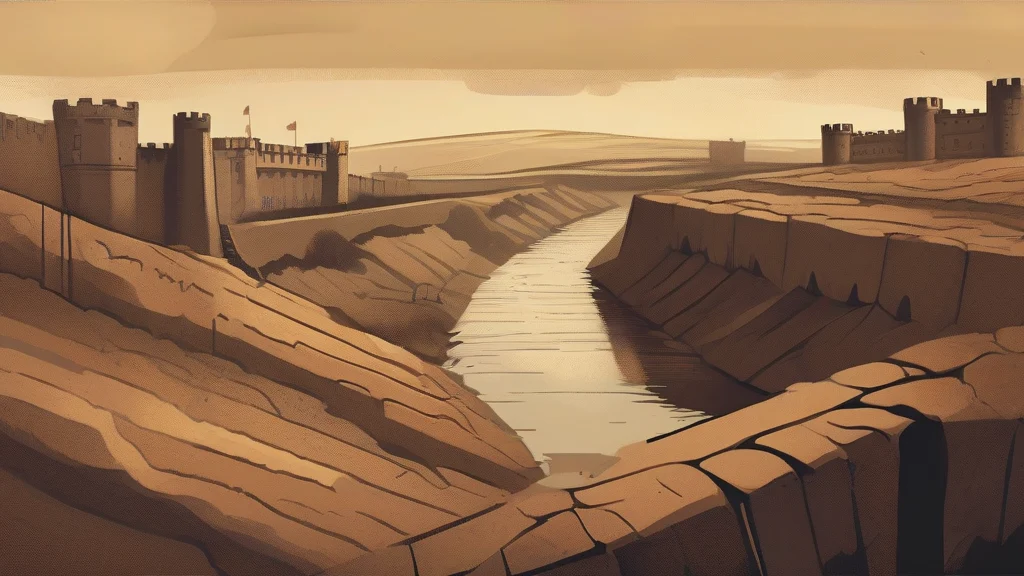
A fosse is a long, narrow ditch or trench, most familiar today as the dry defensive ditch that surrounded medieval castles, hill forts, and other fortifications. When such a ditch was deliberately flooded, it became what we now call a moat; indeed, 'moat' essentially names the water-filled version of a fosse. The word comes from the Latin fossa, meaning a dug trench, itself derived from the verb fodere, 'to dig' — the same root behind 'fossil', literally something dug from the earth. Although fosse rarely appears in casual conversation, it remains standard vocabulary in archaeology, military history, and heritage writing, describing everything from Iron Age rampart ditches to Roman boundary works. Its most famous legacy is England's Fosse Way, a Roman road whose name preserves the memory of the ditch that once ran along its course, keeping the word alive in the modern landscape.
nounA long, narrow ditch or trench, especially one dug as a defensive earthwork around a fortification such as a castle or rampart; when filled with water it forms a moat.
- A ditch or trench dug as a defensive earthwork around a fortification.
- Any long, narrow ditch or excavation in the ground.
"The medieval castle was protected by a deep fosse that encircled the outer walls."
"Archaeologists traced the remains of a Norman fosse surrounding the motte-and-bailey earthwork."
"A shallow fosse crossed the field, marking where an ancient boundary once ran."
The standard plural form is 'fosses'; multiple ditches are typically discussed only in technical archaeological or military-engineering writing.
"The survey recorded two parallel fosses forming the site's outer defences."
England's Fosse Way, one of the longest Roman roads in Britain, takes its very name from the great defensive ditch that ran alongside it.
Reviewed by Deb Chak, Editor. AI-assisted content curated by RJS Tech Solutions LLP.
Etymology of fosse
The English word 'fosse' derives from the Latin fossa, meaning a ditch or trench, formed from the verb fodere, 'to dig'. It entered English through Old French as 'fosse' during the medieval period, when it described the defensive ditches of castles and earthworks. It shares this Latin root with 'fossil' (from fossus, 'dug up'), with the anatomical term 'fossa', and with 'fossette'. The name of Britain's Fosse Way, a major Roman road, reflects the same Latin origin.
How fosse is actually used
Fosse is now chiefly encountered in historical, archaeological, and military-engineering contexts rather than everyday speech. It carries a somewhat archaic, scholarly tone, and modern readers most often meet it in descriptions of castles, hill forts, and Roman earthworks. The word survives notably in place-names and road names, including England's Fosse Way.
Easily confused with fosse
In anatomy, 'fossa' denotes a hollow or depressed area (as in the cranial fossae), whereas 'fosse' refers to an actual ditch or trench dug into the ground.