
What does moss mean?
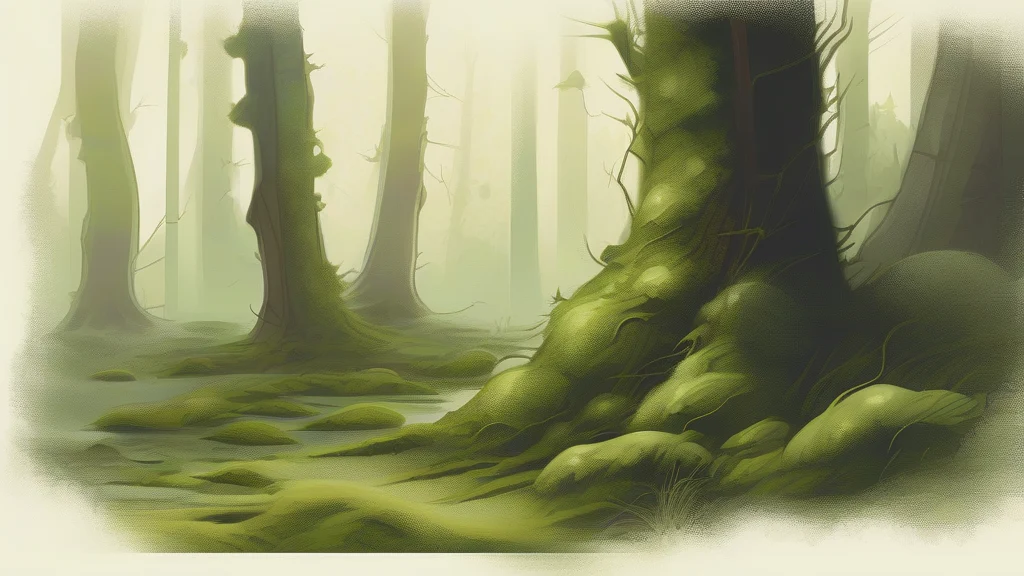
Moss is a small, nonvascular plant that commonly forms dense green cushions on damp soil, rocks, walls, and tree trunks. Unlike most familiar plants, it does not produce flowers or seeds; it reproduces through spores and belongs to a group that includes some of the earliest land plants. In ordinary use, “moss” can refer both to an individual plant and to the green or brownish growth covering a surface. The word often evokes shaded woodland, old buildings, damp stone, and the passage of time, giving it a natural, slightly contemplative atmosphere. As a verb, “to moss” means to cover something with moss, though this use is less common than the noun.
A small, nonvascular plant that typically grows in dense, green cushions on damp soil, rocks, or tree trunks.
"Moss covered the north side of the old stone wall."
Used collectively, the word can refer to a covering of such plants rather than a single plant.
To cover or become covered with moss.
"Years of damp weather had mossed the old garden wall."
Chiefly literary and descriptive; it is less common than the noun.
The plural is used when referring to different kinds of moss or individual plants.
"Several mosses grow along the damp edge of the path."
Mosses are among the earliest land plants to evolve, and their tiny leaves can hold water while helping create the damp microhabitats in which countless other organisms live.
Reviewed by Deb Chak, Editor. AI-assisted content curated by RJS Tech Solutions LLP.
Etymology of moss
The word comes from Old English “mos,” used for moss and related damp vegetation. It developed from Proto-Germanic *musa and has relatives in other Germanic languages, including Dutch “mos” and German “Moos.” The modern spelling was established in Middle English and has remained stable for centuries.
Related word forms
How moss is actually used
The noun is common in descriptions of damp, shaded, or undisturbed environments. In the verb sense, it is much less frequent and is chiefly literary or descriptive.
Easily confused with moss
Mosses are small nonvascular plants, whereas lichens are composite organisms formed from a fungus and usually an alga or cyanobacterium.