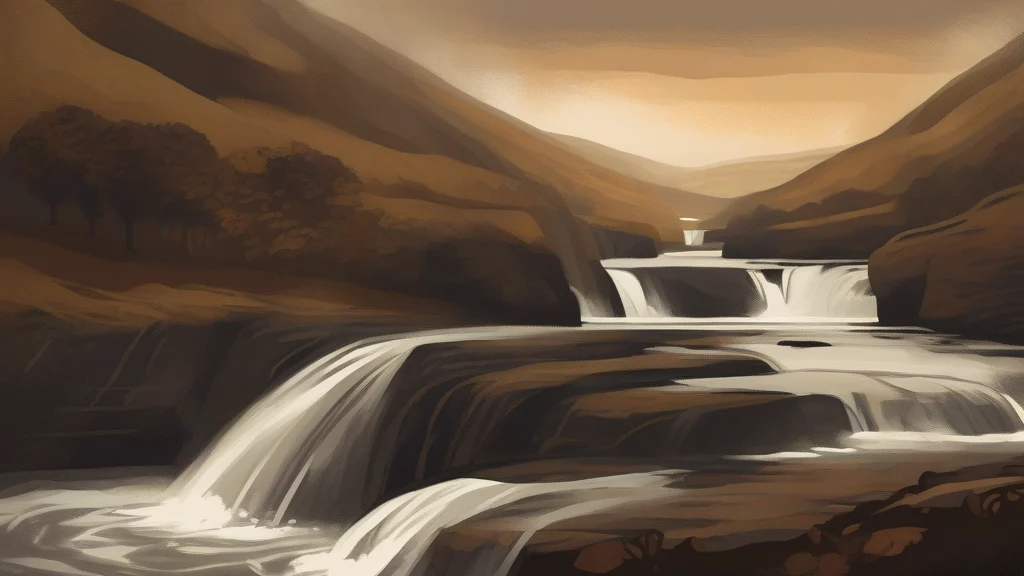
What does foss mean?
Foss is the English descendant of an Old Norse word for a waterfall, carried into Britain by Scandinavian settlers who colonised northern England in the early medieval period. In modern usage it survives almost entirely as part of the landscape's naming tradition: the spectacular falls of Yorkshire, County Durham, Cumbria and Northumberland are frequently called 'forces', a closely related form of the same Norse root, and the word foss itself lingers in local usage and older writing about these northern rivers. Because it is regional rather than general, foss has a distinctly antiquarian, topographical flavour — the kind of word encountered in walking guides, place-name studies and descriptions of the Pennine dales rather than in everyday conversation. For readers elsewhere, it offers a neat illustration of how Viking-age language still underlies the map of northern England: say 'foss' near Aysgarth or High Force, and you are speaking the vocabulary of the settlers who named those torrents a thousand years ago.
nounA waterfall, especially in northern England, where the word descends from Old Norse; the term is largely preserved today in place-names such as Aysgarth Falls and other 'Force' falls.
- A waterfall, particularly in northern England, now found mainly in place-names.
"The beck plunges over the foss into a dark pool below."
"The path climbed steeply beside the foss, its spray soaking us to the skin."
"Local maps mark the spot simply as High Force, the greatest foss on the River Tees."
As a pluralised noun the word is rare, appearing mainly in descriptive or guidebook prose listing several waterfalls.
"The dale is famous for its chain of fosses along the upper river."
In much of northern England, waterfalls are still called 'forces' — a living echo of the very same Old Norse word that gave us 'foss'.
Reviewed by Deb Chak, Editor. AI-assisted content curated by RJS Tech Solutions LLP.
Etymology of foss
The word derives from Old Norse 'foss', meaning a waterfall, brought to Britain by Scandinavian settlers who concentrated in northern England. Its close relative 'force', used for the same feature, preserves the parallel Norse form and dominates the naming of waterfalls across Yorkshire and the far north. The term belongs to the distinctive body of Norse landscape words — alongside fell, beck and garth — that still characterise the geography and speech of the old Danelaw.
How foss is actually used
'Foss' is essentially regional and historical: it survives robustly only in the place-names of the old Danelaw, especially Yorkshire, Cumbria and Northumberland, where waterfalls are commonly named 'Force'. As a standalone term in everyday speech it is rare, and writers today would normally say 'waterfall'.
Easily confused with foss
'Fossick' is an Australian and New Zealand verb meaning to rummage or prospect for minerals or opals, whereas 'foss' is a northern English noun denoting a waterfall.
'Fosse' refers to a ditch or moat (as in the Roman Fosse Way), while 'foss' is a waterfall; the two words have different origins despite their similar sound.