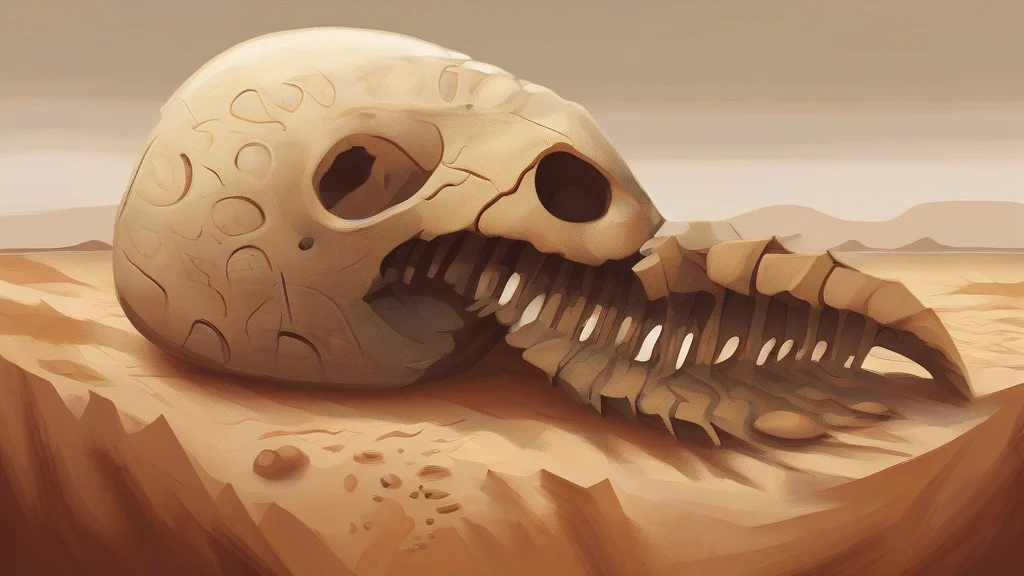
What does fossilization mean?
Fossilization is the process by which something becomes transformed into a fossil or, more generally, fixed into an unchanging state. In its primary scientific sense, it describes how the remains of plants and animals are gradually preserved as fossils: after death, an organism must be quickly buried by sediment, protected from scavengers and decay, so that minerals can slowly replace or fill its tissues over millions of years. This process yields the fossil record on which much of our knowledge of prehistoric life depends. Beyond geology, the term carries productive metaphorical weight: educators and linguists speak of the fossilization of habits, institutions, and even language patterns that have become rigid and immune to change. In second-language research, for instance, fossilization names the phenomenon whereby certain errors become permanent despite ongoing instruction. The word therefore spans both deep time and human behaviour, always describing the same underlying idea — movement arrested, change halted, form preserved.
nounThe process by which organic matter or an organism is turned into a fossil, or, more broadly, the process by which something becomes fixed, rigid, and resistant to change.
- The natural process by which the remains of organisms are preserved as fossils over geological time.
- The figurative process by which something — an idea, institution, habit, or language pattern — becomes fixed, unchanging, and resistant to development.
"The fossilization of the dinosaur's bones took millions of years, preserving remarkable detail."
"Fossilization begins when an organism is rapidly buried under sediment, shielding it from decay."
"Critics warned that the committee's rules had undergone complete fossilization, unable to adapt to modern needs."
The plural is rare and typically appears only when discussing multiple distinct instances or types of the process.
"Different sediments produce different kinds of fossilizations."
In linguistics, 'fossilization' describes errors that get permanently stuck in a learner's second language — some habits really can set like stone.
Reviewed by Deb Chak, Editor. AI-assisted content curated by RJS Tech Solutions LLP.
Etymology of fossilization
Fossilization derives from the verb 'fossilize', formed from 'fossil', which comes from the Latin 'fossilis', meaning 'dug up' or 'obtained by digging', from the root of 'fodere', 'to dig'. In classical Latin, 'fossilis' applied to anything excavated from the earth, including minerals; the modern sense linking fossils to ancient life developed as geology matured in the seventeenth through nineteenth centuries. The English noun 'fossilization' emerged during this scientific period as the process of becoming fossil came to be understood mechanistically. It shares its Latin root with related terms such as 'fossil' and 'fossilize'.
Related word forms
How fossilization is actually used
The word appears in formal and scientific registers, especially paleontology and geology. In applied linguistics it has a specialized technical meaning referring to the persistence of errors in second-language acquisition despite continued learning. As a figurative term it often carries a negative connotation of stagnation or rigidity.
Easily confused with fossilization
Petrification specifically means being turned to stone, while fossilization is the broader process of remains being preserved in rock, which may or may not involve mineral replacement.