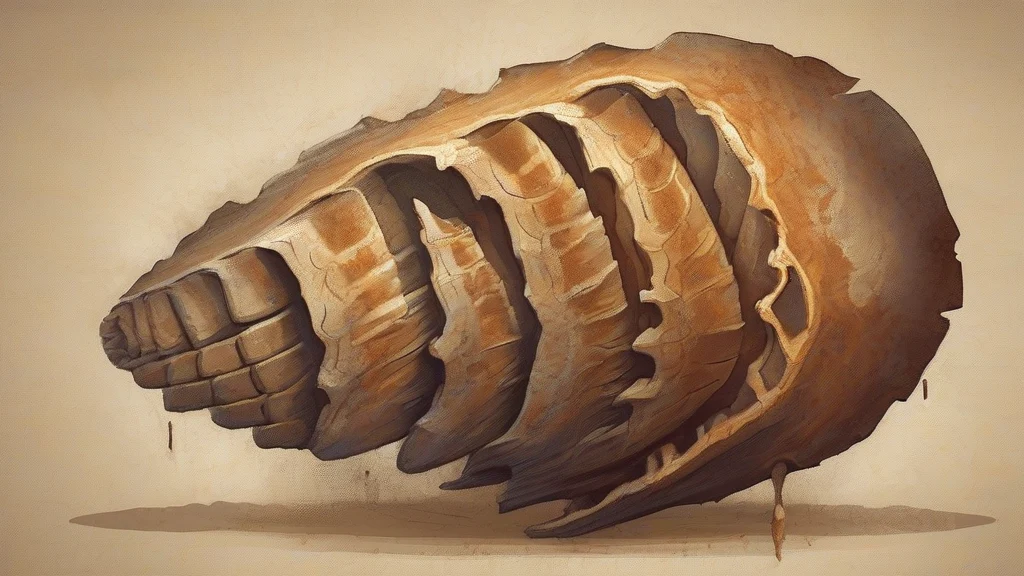
What does fossilized mean?
Fossilized describes matter—typically bone, shell, wood, or plant material—that has been transformed into a fossil through long-term natural preservation, usually when minerals gradually replace the original organic tissue after burial in sediment. By extension, the adjective is applied figuratively to ideas, practices, institutions, or language that have become rigid, antiquated, and resistant to change, as in 'fossilized attitudes' or 'a fossilized bureaucracy.' The literal sense belongs chiefly to scientific contexts such as palaeontology and geology, where it signals evidence of ancient life; the figurative sense carries a clearly negative connotation, suggesting stagnation rather than stability. The word derives from the verb fossilize, itself rooted in the Latin fossilis, meaning 'obtained by digging.' Because fossils preserve traces of organisms from millions of years ago, fossilized things are often imagined as windows into deep time—a quality that makes the term vivid whether used of ancient bone or an outdated way of thinking.
adjective (past participle of the verb 'fossilize')Preserved as a fossil, or having become rigid, outdated, or incapable of change through long disuse of fresh ideas or adaptation.
- (Of organic matter) having been turned into a fossil by natural preservation over geological time.
- (Of ideas, habits, or institutions) having become rigid, fixed, or hopelessly outmoded through resistance to change.
"The museum displayed a fossilized fern frond preserved in shale for millions of years."
"Scientists discovered fossilized dinosaur tracks along the riverbed."
"Critics accused the institution of fossilized thinking, unwilling to reform even as its audience vanished."
The word 'fossil' comes from Latin fossilis, meaning 'dug up from the ground' — so every fossilized specimen is literally something the earth excavated for us.
Reviewed by Deb Chak, Editor. AI-assisted content curated by RJS Tech Solutions LLP.
Etymology of fossilized
Fossilized comes from the verb fossilize, formed from the noun fossil, which derives from the Latin fossilis, meaning 'dug up from the earth.' In early modern science the term was applied broadly to anything unearthed from rock before its modern restriction to preserved organic remains took hold in the late eighteenth and nineteenth centuries. The English word fossil entered use around the mid-sixteenth century, with fossilize and its participial form fossilized developing later. Cognates appear across European languages, including French fossile and Italian fossile, all tracing back to the same Latin root.
Related word forms
How fossilized is actually used
Both a literal scientific term and a figurative one; the figurative use carries a negative connotation, implying inflexibility or obsolescence. Common in palaeontology and geology writing, and in social or political criticism.
Easily confused with fossilized
'Petrified' means turned to stone (and colloquially means terrified), whereas 'fossilized' specifically refers to remains replaced by minerals over geological time or, figuratively, to becoming outdated.