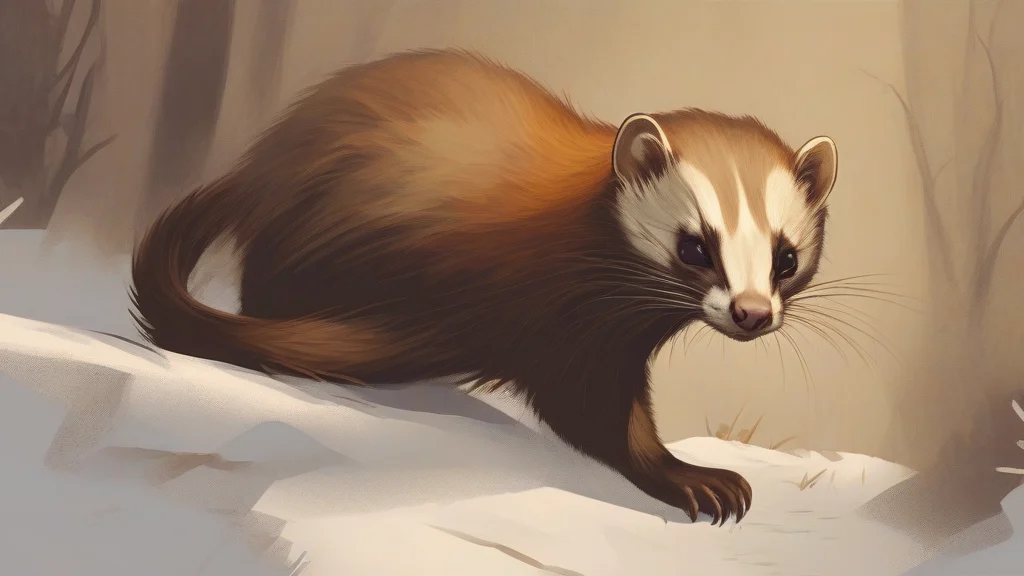
What does foulmart mean?
Foulmart is an old English vernacular name for the European polecat (Mustela putorius), a small, fierce member of the weasel family native to Britain and continental Europe. The name combines 'foul', referring to the animal's powerful musky scent, with 'mart', an older term for martens and polecats generally. Historically, the foulmart was well known — and often loathed — in the British countryside, where it preyed on poultry and game birds and was accordingly persecuted by farmers and gamekeepers. The word belongs largely to rural and hunting vocabulary of past centuries, and modern speakers encounter it mainly in natural-history writing, dialect records, and literature dealing with country life. Today the animal itself is simply called a polecat, and after a serious decline its populations have partly recovered. Foulmart survives chiefly as a charmingly pungent piece of English rural lexicon.
nounThe European polecat (Mustela putorius), a small carnivorous mammal of the weasel family, so named for its strong musky odour.
- The European polecat (Mustela putorius), especially in older British rural usage.
"The gamekeeper found a foulmart raiding the pheasant pens at dawn."
"The trapper baited his snares against the foulmart that had been taking young rabbits."
"In old country accounts, the foulmart was cursed as the chief enemy of the poultry yard."
The plural is regular; the variant spelling 'foumart(s)' appears in older sources.
"Several foulmarts were blamed for the season's losses among the game birds."
It's named after its smell: the 'foul' in foulmart comes straight from the polecat's notorious musk.
Reviewed by Deb Chak, Editor. AI-assisted content curated by RJS Tech Solutions LLP.
Etymology of foulmart
Foulmart derives from Middle English, formed from 'foul', meaning filthy or ill-smelling, and 'mart', a medieval term for marten-like animals. The compound reflects the European polecat's famously strong musky odour, which made a lasting impression on the countryside folk who named it. It is thus closely related in origin to other mustelid names such as 'marten' and 'polecat', all describing the same family of slender carnivores.
Related word forms
How foulmart is actually used
This is an archaic or regional dialect term, once common among gamekeepers and countrymen in Britain; today writers almost invariably use 'polecat'. The variant spelling 'foumart' also appears in older texts.
Easily confused with foulmart
Despite the similar opening sound, 'foulmart' refers to a polecat, not to any kind of farmyard bird.
A marten is a related but distinct tree-dwelling mustelid; 'foulmart' specifically denotes the ground-dwelling polecat and incorporates 'mart' merely as an old word for such animals.