What does foundering mean?
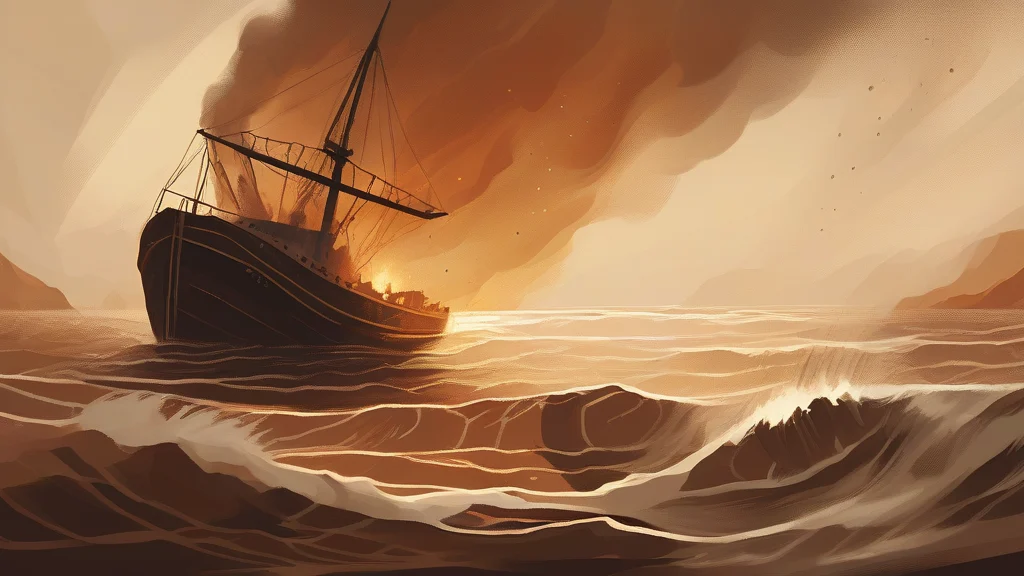
"Foundering" is the present participle of the verb "founder," describing the act of sinking or collapsing completely. Its oldest and most literal sense belongs to the sea: a vessel founders when it fills with water and goes down. By extension, the word came to describe any enterprise that fails outright — a foundering company, government, or negotiation has run onto trouble so severe that recovery is doubtful. This gives the word a distinctly graver tone than its near-relative "floundering," which suggests clumsy struggle rather than final ruin; a flounder may yet right itself, but a founder goes under. Derived ultimately from Old French, and sharing deep roots with words like "fund" and "foundation," it remains a staple of maritime history and financial journalism alike, valued precisely because it signals not merely difficulty but decisive failure.
(Of a ship) to sink or fill with water and be lost; (of an undertaking, company, or person) to fail utterly or collapse.
"The ferry was foundering off the coast before rescue vessels arrived."
Almost always used in progressive forms such as "is foundering" or "was foundering," reflecting an ongoing process of decline or sinking.
The action or state of sinking, failing, or collapsing.
"The foundering of the shipping firm cost thousands of jobs."
A ship can flounder for hours, but when it founders, it goes to the bottom — and English borrowed the word from the French for 'to crash to the ground.'
Reviewed by Deb Chak, Editor. AI-assisted content curated by RJS Tech Solutions LLP.
Etymology of foundering
"Foundering" derives from the verb "founder," which entered English in the Middle Ages from Old French "fondrer" (modern French "s'effondrer"), meaning to plunge downward or crash to the ground; it is generally traced back to Latin "fundus," meaning bottom, which also gave English "fund," "refund," and "foundation." The nautical sense — of a ship filling with water and sinking — developed early, since a vessel that takes on water literally descends to the bottom. The same root produced "foundry" by way of French "fondre," to melt or pour metal.
Related word forms
How foundering is actually used
"Foundering" carries a strong connotation of terminal failure — something beyond saving — which distinguishes it from the milder sense of mere struggle conveyed by "floundering." In nautical contexts it retains a formal, technical flavor; in business and political writing it is common metaphorical shorthand for collapse.
Easily confused with foundering
'Floundering' means struggling clumsily or thrashing about without progress, while 'foundering' means sinking outright or failing completely — a flounder struggles but stays afloat; a founder goes down.